


 Contact Now


Send Message
Privacy statement: Your privacy is very important to Us. Our company promises not to disclose your personal information to any external company with out your explicit permission.
Products
Model No.: ST -Bitter Melon Extract
Types Of: Herbal Extract
Traits: Powder
Location: Bark, Leaf, Seed
Extraction Method: Liquid-Solid Extraction
Package: Bottle, Drum
Product Name: Bitter Melon Extract 10% Charantin
Botanical Source: Momordica charantia L.
Plant Part Used: Immature fruit, deseeded
Raw Material Description: Seed-free immature bitter melon fruit
Grade: Food Grade / Dietary Supplement Grade
Appearance: Yellow-brown to light brown powder; color may vary with processing
Charantin Assay: ≥10.0%
CAS Number: 90063-94-8
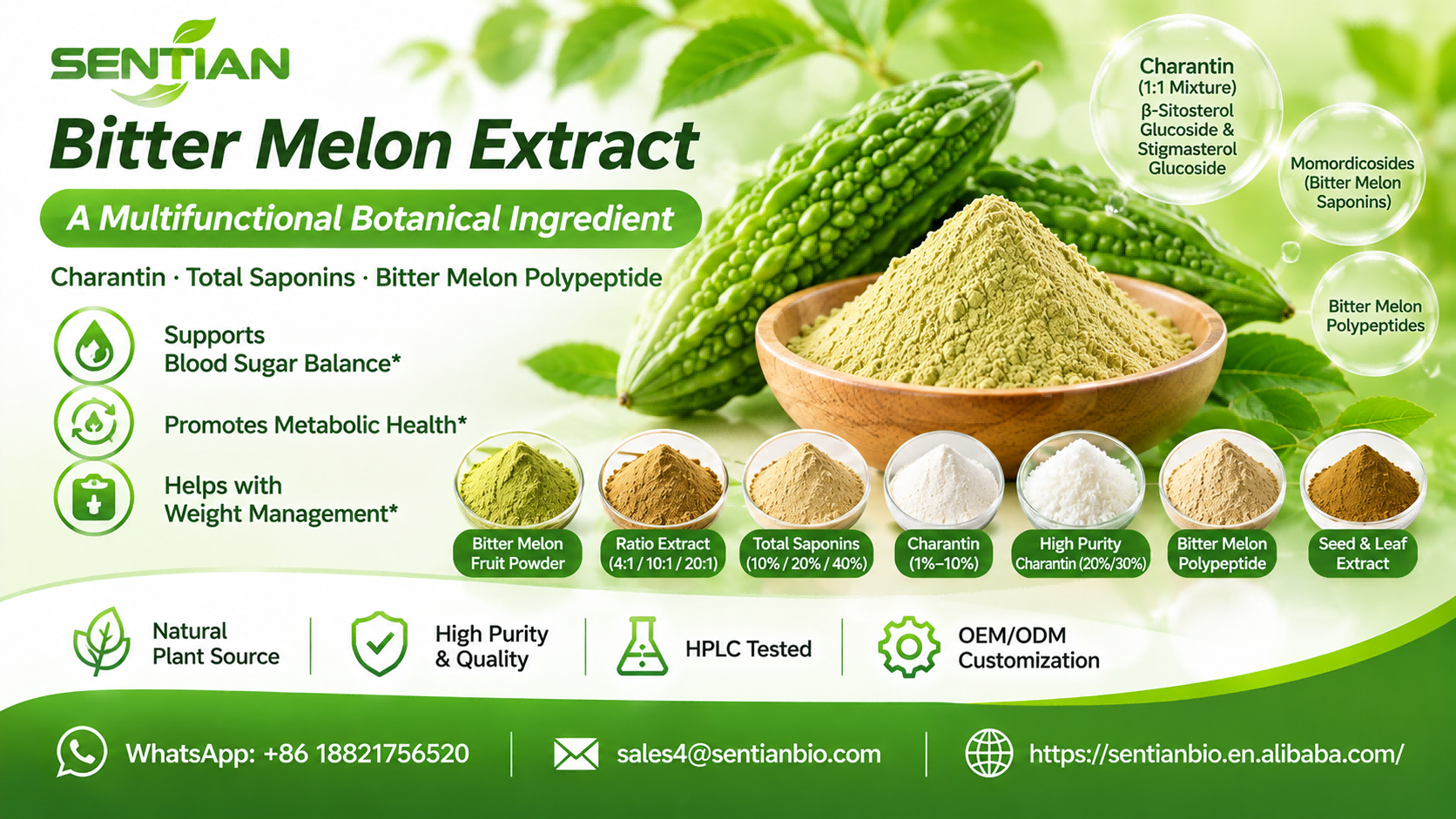
Bitter melon extract is a botanical ingredient derived from Momordica charantia L., a member of the Cucurbitaceae family. Also known as bitter gourd or karela, bitter melon has a history of use in traditional food and herbal preparations. Its fruit contains several groups of phytochemicals, including cucurbitane-type triterpenoids, steroidal glycosides, flavonoids, phenolic compounds, and polysaccharides.
This product is a standardized bitter melon fruit extract with a Charantin content of at least 10.0% by HPLC, calculated on a dry basis. It is produced from immature, deseeded fruit and is intended for food-grade and dietary supplement-grade formulation development. The seed-free raw material specification distinguishes this product from extracts made using whole fruit or seed-containing material.
Charantin is not a single chemical compound. It refers to a mixture primarily associated with beta-sitosteryl glucoside and stigmasteryl glucoside. Therefore, a Charantin percentage should be reported on a clearly defined mixture basis, rather than being treated as the concentration of one individual molecule.
Bitter melon ingredients are available in several forms, including whole-fruit powder, ratio extracts, total saponin extracts, and Charantin-standardized extracts. These product types have different compositions and analytical definitions. A 10:1 extraction ratio, for example, does not indicate 10% Charantin or 10% total saponins.
| Parameter | Specification |
|---|---|
| Product Name | Bitter Melon Extract 10% Charantin |
| Botanical Source | Momordica charantia L. |
| Plant Part Used | Immature fruit, deseeded |
| Raw Material Description | Seed-free immature bitter melon fruit |
| Grade | Food Grade / Dietary Supplement Grade |
| Appearance | Yellow-brown to light brown powder; color may vary with processing |
| Charantin Assay | ≥10.0% by HPLC, on a dry basis |
| Reporting Basis | As Charantin, mixture basis |
| Total Saponins | Separate optional specification; not interchangeable with Charantin assay |
| CAS Number | 90063-94-8 (commercial extract mixture CAS) |
| Molecular Formula | No single molecular formula for the extract or Charantin mixture |
| Molecular Weight | No single molecular weight for the extract or Charantin mixture |
| Charantin Component 1 | β-Sitosteryl glucoside, C35H60O6, 576.85 g/mol |
| Charantin Component 2 | 5,22-Stigmasteryl glucoside, C35H58O6, 574.84 g/mol |
| Moisture | ≤5.0% |
| Ash | ≤5.0% |
| Particle Size | ≥95% passing through 80–100 mesh |
| Optional Particle Size | 200 mesh or micronized grade ≤30 μm |
| Bulk Density | 0.35–0.60 g/mL |
| Solubility | Depends on extraction and carrier system; some grades disperse in water, while purified Charantin is poorly water-soluble |
| Storage | Store sealed in a cool, dry place, protected from light, at ≤25°C |
| Shelf Life | 24 months, subject to validated product specifications |
Bitter melon contains several phytochemical groups that have been investigated in relation to glucose metabolism and metabolic health. Charantin, a mixture of steroidal glycosides, is one of the commonly referenced marker components in standardized bitter melon extracts. Other constituents, including momordicosides and cucurbitane-type triterpenoids, are also studied for their potential biological activities.
Research on bitter melon has explored several possible pathways associated with glucose regulation. These include glucose uptake, insulin-related signaling, carbohydrate metabolism, and enzymes involved in glucose production and utilization. Certain bitter melon preparations have also been investigated in preclinical and clinical studies involving blood glucose and metabolic markers. However, the chemical composition of different extracts varies considerably, and findings from one preparation cannot automatically be applied to every Charantin-standardized product.
The fruit also contains phenolic compounds and flavonoids that have been studied for antioxidant activity. These compounds may contribute to the overall phytochemical profile of the extract, but their concentrations are not defined by the Charantin assay alone. A product standardized to 10% Charantin should therefore not be described as containing 10% total saponins or 10% of all bitter melon active constituents.
Bitter melon extract has a naturally pronounced bitter taste. This characteristic can affect consumer acceptance, particularly in powders, chewable tablets, and ready-to-mix beverages. Formulation strategies may include flavor masking, sweetening systems, or encapsulation technologies. Beta-cyclodextrin and suitable flavor systems may be considered during development, depending on the formulation and processing conditions.
The solubility of the ingredient is also influenced by its extraction method and carrier content. Water-based extracts and carrier-containing powders may disperse more readily than purified Charantin-rich materials. High-proportion ethanol extracts and purified steroidal glycosides may show limited water dispersibility. Formulators should select the grade according to the intended dosage form rather than assuming that all bitter melon extracts are water-soluble.
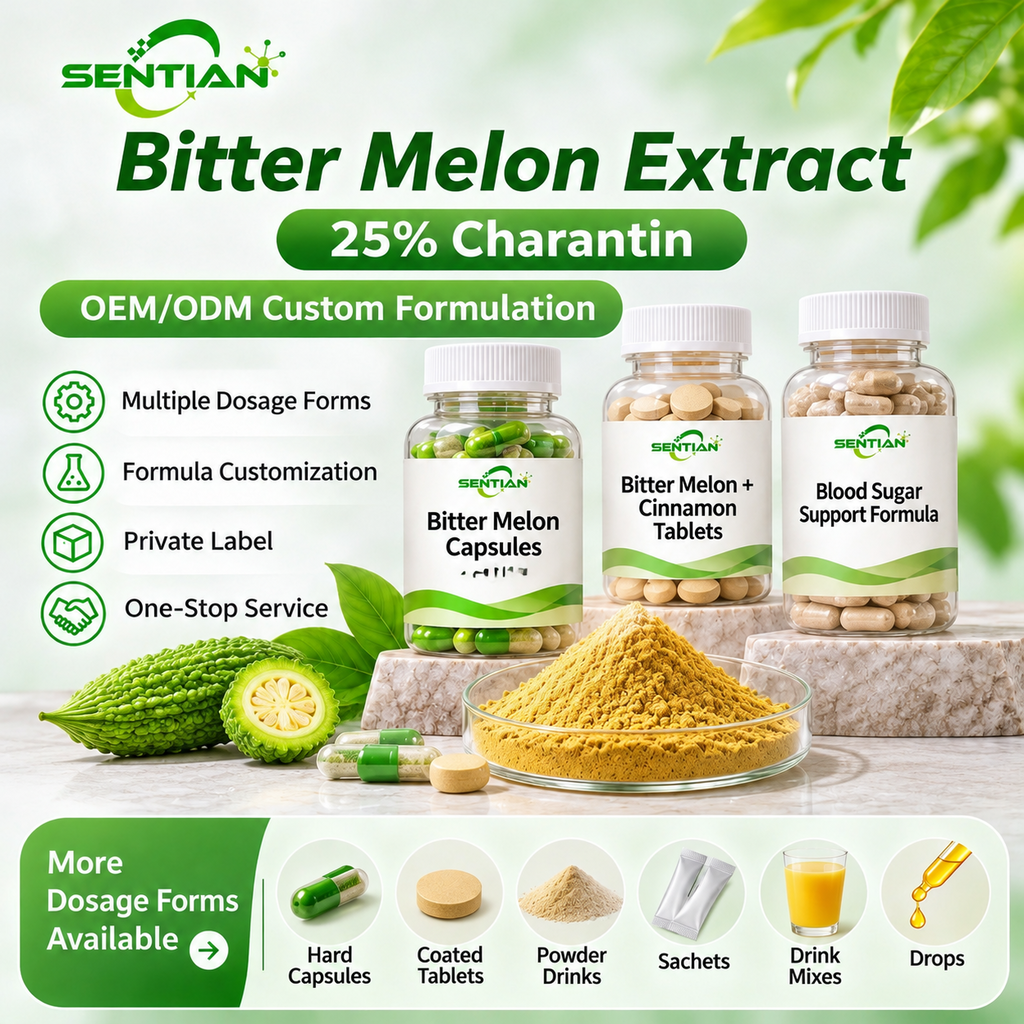
Bitter melon extract 10% Charantin HPLC can be used in capsules and tablets designed for dietary supplement formulations. Its standardized marker content provides a defined analytical parameter for ingredient selection and batch comparison. Particle size, moisture, powder flow, and compatibility with other ingredients should be assessed during tablet blending and compression.
In blood sugar and metabolic health formulations, bitter melon extract may be combined with ingredients such as cinnamon, alpha-lipoic acid, chromium compounds, or berberine. These combinations are formulation concepts rather than evidence that each ingredient produces a specific clinical outcome. Dosage, ingredient interactions, target population, and applicable labeling requirements should be evaluated independently.
For weight-management and general wellness products, bitter melon ingredients may be incorporated into capsules, powdered blends, meal-replacement products, and solid beverages. Ratio extracts and whole-fruit powders may be suitable for applications where a defined Charantin assay is not required. Products that require a specific marker level should use a standardized extract with an appropriate analytical method.
Functional food applications include nutrition powders, compressed confectionery, tea blends, and selected beverage mixes. Because bitter melon has a strong bitter profile and some extract grades have limited water dispersibility, flavor balance and dispersion properties should be considered early in product development.
The extract may also be included in traditional botanical combinations with fenugreek, Swertia chirayita, or gymnema. For these multi-ingredient products, the botanical identity, plant part, extraction method, and standardization of each ingredient should be documented separately.
The lead specification is Charantin at not less than 10.0% by HPLC-DAD/UV, typically using a wavelength in the 205–210 nm range, or an appropriately validated HPLC-ELSD method. The analytical procedure should identify the reference material, calibration approach, sample preparation, calculation basis, and reporting convention. The result should be stated as Charantin on a mixture basis.
Total cucurbitane saponins are a separate analytical category. If measured by a UV-Vis colorimetric method using a vanillin-based reaction, the result should be reported as total saponins with the stated reference basis. It should not be presented as equivalent to the HPLC Charantin assay. Similarly, a 4:1, 10:1, or 20:1 extraction ratio describes the relationship between starting botanical material and extract output; it is not an active-constituent percentage.
A chromatographic fingerprint can provide additional information about the extract profile, including characteristic momordicoside-related peaks. Identity testing may include TLC and HPLC retention-time comparison. Other quality parameters may include heavy metals by ICP-MS, pesticide residues by GC-MS/MS and LC-MS/MS, residual solvents by headspace GC, and microbiological testing.
The COA should state the botanical source as Momordica charantia L. and the plant part used as immature, deseeded fruit. For products made with seed-containing material, the plant-part description should clearly disclose the presence of seeds. Seed-containing and deseeded fruit extracts should not be treated as identical raw materials. Batch documentation may include chromatograms, a safety data sheet, a technical data sheet, allergen and non-GMO statements, and applicable quality-system certificates.
Product Categories : Raw Health Products > Plant Extract


Home > Products > Raw Health Products > Plant Extract > Bitter Melon Extract 10% Charantin HPLC


Send Inquiry

Ms. Linda
Tel:
Fax:
Mobile Phone:+86 18602905487
Email:sales3@sentianbio.com
Address:Room 2002, Building B, Economic Development Building, Weiyang District, Xian, Shaanxi
Mobile Site

Privacy statement: Your privacy is very important to Us. Our company promises not to disclose your personal information to any external company with out your explicit permission.
Fill in more information so that we can get in touch with you faster
Privacy statement: Your privacy is very important to Us. Our company promises not to disclose your personal information to any external company with out your explicit permission.