


 Contact Now


Send Message
Privacy statement: Your privacy is very important to Us. Our company promises not to disclose your personal information to any external company with out your explicit permission.
Products


Model No.: ST-Escin
Types Of: Herbal Extract
Traits: Powder
Location: Bark
Extraction Method: Liquid-Solid Extraction
Package: Bottle, Plastic Container
Place Of Origin: China
Product Name: Horse Chestnut Extract
Botanical Name: Aesculus hippocastanum L.
Active Constituents: Escin (Aescin)
Plant Part Used: Seeds
Extract Type: Standardized Powder Extract
Main Specifications: 20% Escin, 40% Escin, 98% Escin
Standardization Method: HPLC
Common Form: Fine Botanical Powder
Alternative Form: Liquid Extract, available upon request
Identification Method: HPLC
Heavy Metals: Tested according to applicable specifications
Microbiological Testing: Available
Moisture: Tested according to product specifications
Ash: Tested according to product specifications
Quality Documentation: Certificate of Analysis (COA)
Main Formulation Applications: Dietary Supplements, Cosmetics, Topical Preparations
Transportation: Ocean,Land,Air,Express
Supply Ability: 100000KGS
Port: SHANGHAI,BEIJING,QINGDAO
Payment Type: T/T,Paypal
Incoterm: FOB,EXW,FCA,DDP,Express Delivery



Escin, also known as aescin, is a naturally occurring mixture of triterpenoid saponins obtained from the seeds of horse chestnut (Aesculus hippocastanum L.). It is the principal group of active constituents used to characterize standardized horse chestnut seed extracts.
Horse chestnut extract is commonly processed into a standardized powder to provide a defined escin content. Unlike conventional ratio-based botanical extracts, standardized escin powder is characterized by its active constituent concentration, making it suitable for formulations that require consistent ingredient specifications.
Commercial grades of horse chestnut extract are available at different escin concentrations, including 20%, 40%, and 98%, typically determined by High-Performance Liquid Chromatography (HPLC). Among these grades, 20% escin is a commonly used specification for general supplement formulations, while higher concentrations may be selected for applications requiring more concentrated botanical ingredients.
Escin is primarily associated with venous health formulations and topical cosmetic products. Its formulation applications include dietary supplement capsules, tablets, creams, gels, and ointments. The selection of an appropriate grade depends on the intended application, target concentration, formulation characteristics, and applicable regulatory requirements.
The extract is generally supplied as a standardized powder. Liquid extract formats may also be considered for specific formulation requirements. Standardized escin content provides a more meaningful specification for ingredient identification and quality control than extraction ratios alone.
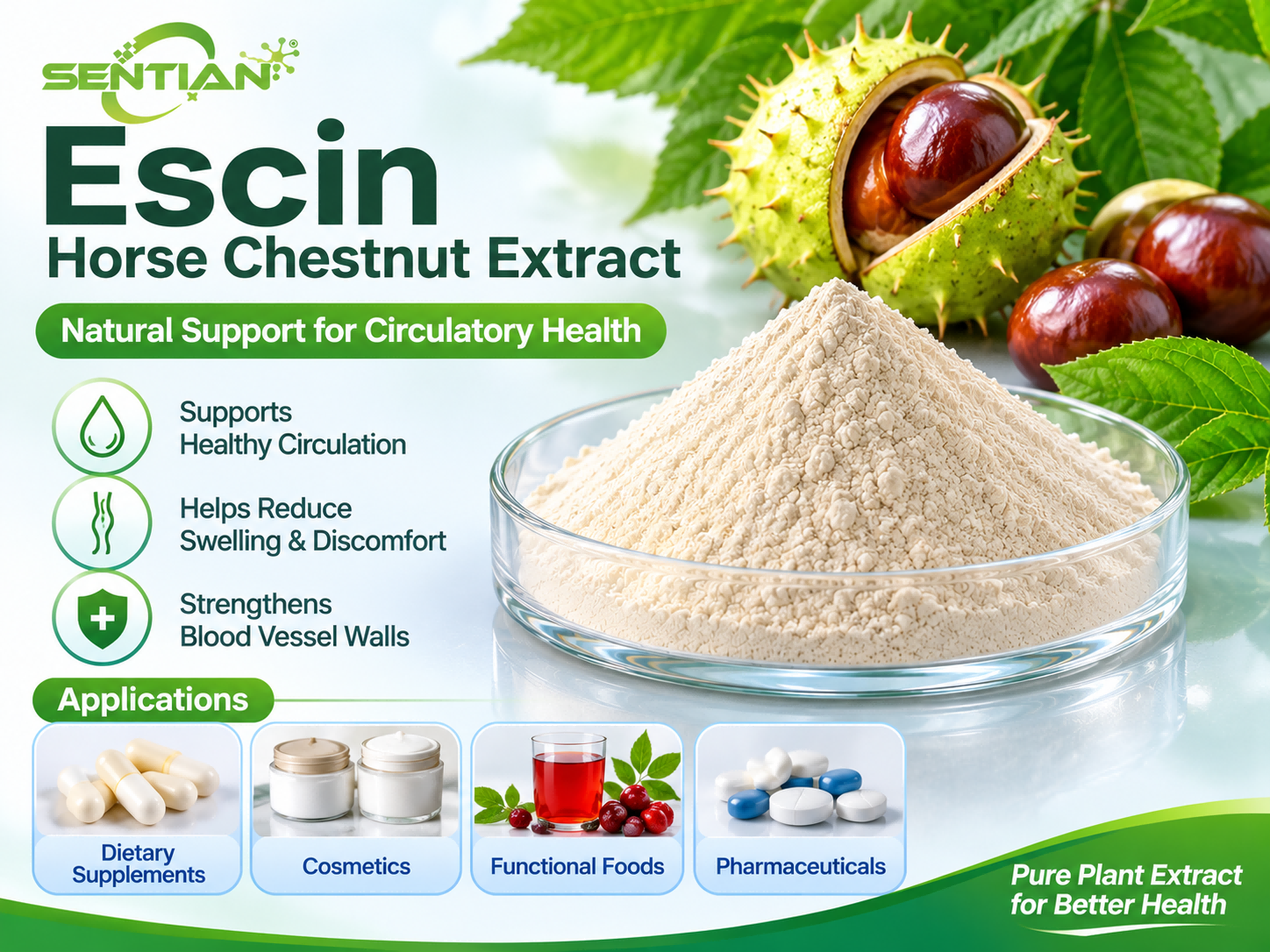

Escin is the primary standardization marker of horse chestnut seed extract. As a group of triterpenoid saponins, it provides a measurable chemical characteristic for evaluating extract composition and batch consistency.
In botanical ingredient manufacturing, escin concentration is an important factor when selecting horse chestnut extract. Standardized extracts allow formulators to calculate ingredient quantities according to the specified active constituent level rather than relying exclusively on the original plant-to-extract ratio.
Different escin concentrations serve different formulation requirements.
20% Escin Extract
The 20% escin grade is a commonly selected specification for general dietary supplement and botanical formulation applications. It provides a standardized active constituent level that can be incorporated into capsules and tablets alongside other botanical ingredients and excipients.
40% Escin Extract
The 40% escin grade offers a higher concentration of the characteristic saponin constituents. It may be considered when a formulation requires a more concentrated horse chestnut ingredient or when the formulation design specifies a higher escin contribution.
98% Escin Extract
The 98% escin grade represents a highly concentrated specification. It is more suitable for specialized ingredient applications and formulations that require a high level of escin standardization. Its suitability depends on the intended use, processing conditions, and applicable safety and regulatory requirements.
From a formulation perspective, the selection of escin concentration should consider the required active constituent contribution, powder handling properties, compatibility with other ingredients, and the analytical requirements of the finished product.

1. Dietary Supplements
Horse chestnut extract is used as a botanical ingredient in dietary supplement formulations targeting venous health and leg circulation. Common finished product formats include hard capsules, tablets, and multi-ingredient botanical blends.
The 20% and 40% escin grades can be evaluated according to the intended formulation concentration and product specifications. Manufacturers may combine horse chestnut extract with other botanical ingredients depending on the formulation concept and regulatory framework.
Ingredient standardization is important in this application because it allows the escin contribution to be calculated and documented. HPLC analysis can be used to verify the specified escin concentration in the raw material.
2. Skincare and Cosmetic Formulations
Horse chestnut extract is also incorporated into cosmetic and personal care formulations. Products may include creams, lotions, gels, and other topical preparations.
In cosmetic formulation development, the selected extract grade should be evaluated for compatibility with the formulation base, processing temperature, pH conditions, and other functional ingredients.
Water-based and emulsion systems may require preliminary compatibility and stability testing. The final selection should also consider the solubility and dispersion characteristics of the specific extract grade.
3. Topical Gels, Creams, and Ointments
Escin-containing horse chestnut ingredients may be used in topical product development, including gels, creams, and ointments designed for external application.
Formulators should evaluate the ingredient's compatibility with thickening agents, emulsifiers, preservatives, and other formulation components. Stability testing and finished-product assessment are necessary to establish suitable processing and storage conditions.
4. Herbal and Botanical Preparations
Standardized horse chestnut extract may also be considered for specialized herbal preparations and botanical ingredient combinations.
In these applications, escin content provides a useful analytical parameter for ingredient identification, quality evaluation, and formulation documentation. The intended product category determines the applicable ingredient requirements and regulatory considerations.

Horse chestnut seed extract contains a mixture of naturally occurring compounds, with triterpenoid saponins collectively referred to as escin serving as the principal standardization target.
The composition of the extract depends on the botanical raw material, extraction process, purification procedures, and subsequent processing conditions. Consequently, different extract grades may exhibit different escin concentrations and accompanying botanical constituents.
Standardization by HPLC is an important quality control approach for horse chestnut extract. It provides an analytical method for determining escin content and verifying whether the ingredient meets its declared specification.
For commercial ingredient evaluation, the following specifications are particularly relevant:
20% Escin HPLC: A commonly selected standardization grade for general botanical and dietary supplement applications.
40% Escin HPLC: A higher-concentration grade for formulations requiring increased escin content.
98% Escin HPLC: A highly concentrated grade for specialized applications with specific standardization requirements.
In addition to escin content, raw material quality evaluation generally includes heavy metal analysis, microbiological testing, moisture determination, and ash measurement. These parameters help assess the quality and consistency of botanical ingredients.
A Certificate of Analysis (COA) should document the analytical results of the corresponding batch. Buyers and formulation developers can use this information to evaluate compliance with internal specifications and applicable quality requirements.
For ingredient selection, the declared escin percentage, analytical method, batch documentation, and intended formulation application should be considered together. This approach supports consistent raw material evaluation and provides a clear technical basis for incorporating horse chestnut extract into dietary supplement, cosmetic, and topical product formulations.
Product Categories : Raw Health Products > Plant Extract


Home > Products > Raw Health Products > Plant Extract > Horse Chestnut Extract 20% 40% 98% Escin HPLC


Send Inquiry

Ms. Linda
Tel:
Fax:
Mobile Phone:+86 18602905487
Email:sales3@sentianbio.com
Address:Room 2002, Building B, Economic Development Building, Weiyang District, Xian, Shaanxi
Mobile Site

Privacy statement: Your privacy is very important to Us. Our company promises not to disclose your personal information to any external company with out your explicit permission.
Fill in more information so that we can get in touch with you faster
Privacy statement: Your privacy is very important to Us. Our company promises not to disclose your personal information to any external company with out your explicit permission.