


 Contact Now


Send Message
Privacy statement: Your privacy is very important to Us. Our company promises not to disclose your personal information to any external company with out your explicit permission.
Products
Model No.: ST-Quercetin
Types Of: Herbal Extract
Traits: Powder
Extraction Method: Liquid-Solid Extraction
Package: Bottle, Drum
Product Name: Quercetin
CAS Number: 117-39-5
Molecular Formula: C₁₅H₁₀O₇
Botanical Source: Sophora japonica L.
Plant Part Used: Dried flower buds
Standardization: ≥95.0% by HPLC
Appearance: Yellow to yellow-green crystalline powder
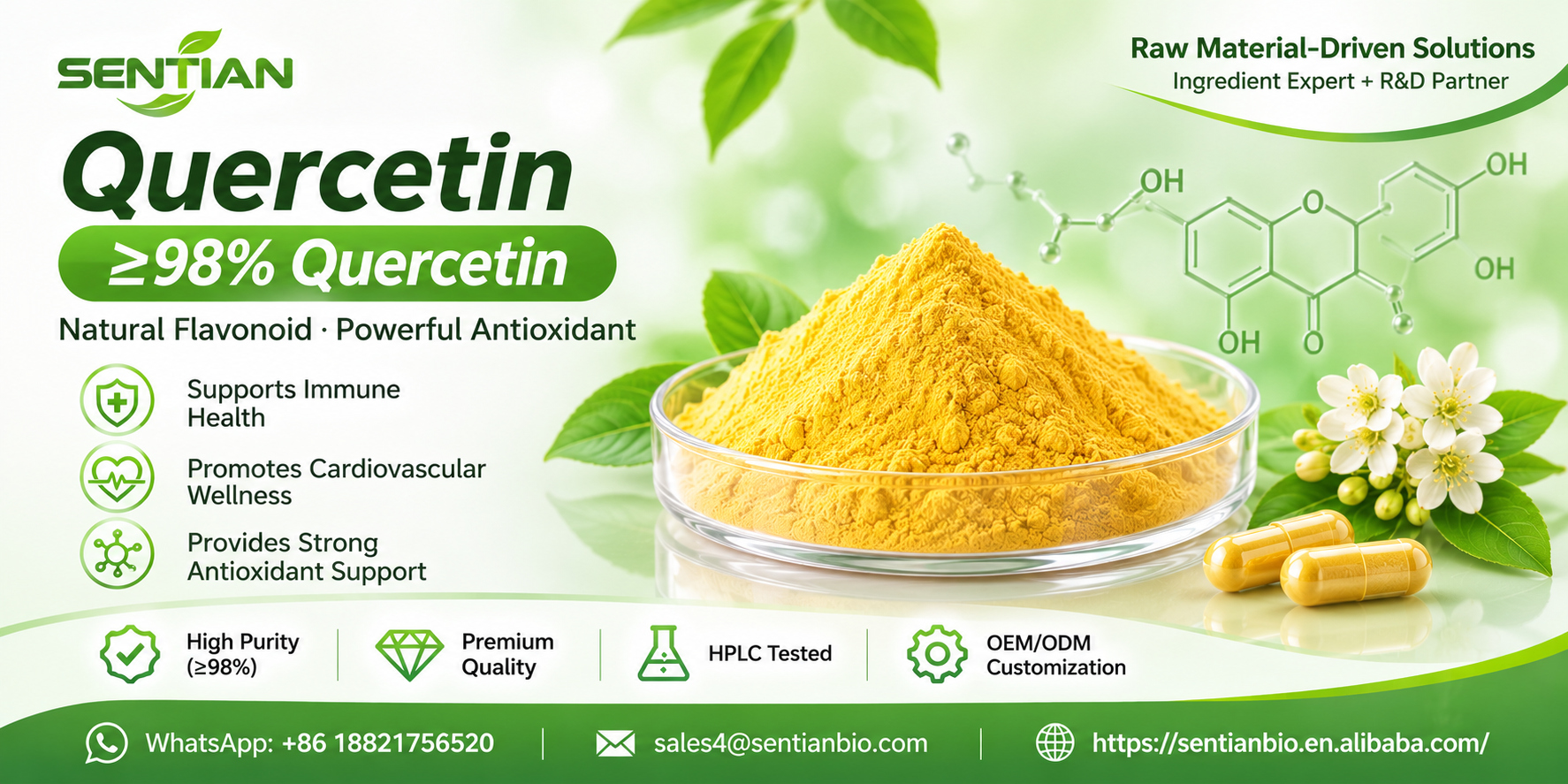
Quercetin is a naturally occurring flavonol belonging to the flavonoid family. It is found in various plants, including Sophora japonica L., onion, buckwheat, apple, and Ginkgo biloba. Commercial Quercetin 95% HPLC is commonly standardized from the dried flower buds of Sophora japonica L., also known as Flos Sophorae Immaturus or Chinese sophora flower buds.
The featured ingredient is a food-grade or dietary-supplement-grade extract standardized to at least 95.0% Quercetin by HPLC on a dry basis. It is supplied as a yellow to yellow-green crystalline powder. The specification refers to the quercetin aglycone content and should be distinguished from specifications calculated on a dihydrate basis.
Quercetin is used in dietary supplement capsules, tablets, powders, and multi-ingredient nutritional formulations. Its scientific research profile includes antioxidant activity, inflammatory pathway regulation, vascular function, and metabolic signaling. From a formulation perspective, its low water solubility, natural color, and slightly bitter taste are important considerations when selecting the appropriate dosage form.
| Parameter | Specification |
|---|---|
| Product Name | Quercetin (Anhydrous Quercetin) |
| CAS Number | 117-39-5 (anhydrous); 6151-25-3 (dihydrate) |
| Molecular Formula | C₁₅H₁₀O₇ (anhydrous); C₁₅H₁₀O₇·2H₂O (dihydrate) |
| Molecular Weight | 302.24 g/mol (anhydrous); 338.27 g/mol (dihydrate) |
| EC Number | 204-187-1 |
| Botanical Source | Sophora japonica L. |
| Plant Part Used | Dried flower buds (Flos Sophorae Immaturus) |
| Standardization | ≥95.0% by HPLC, dry basis |
| Optional Grades | 98% HPLC; 95% UV; micronized 95%; water-dispersible grade |
| Appearance | Yellow to yellow-green crystalline powder |
| Odor and Taste | Nearly odorless; slightly bitter and astringent |
| Solubility | Practically insoluble in water; soluble in ethanol and alkaline media |
| Melting Point | Approximately 316°C, with decomposition |
| Particle Size | Typically ≥95% through 80 mesh; optional 100 mesh or D90 ≤20 μm |
| Bulk Density | Approximately 0.3–0.5 g/mL, depending on particle size |
| Loss on Drying | ≤0.5% for anhydrous material or an agreed limit for dihydrate material |
| Ash | ≤1.0% |
| pH | Approximately 4.5–6.5 in a 1% suspension |
| Assay Method | HPLC with UV detection |
| Identity Testing | HPLC retention-time comparison and UV spectrum; LC-MS when required |
| Heavy Metals | ICP-MS: Pb ≤3, As ≤1, Cd ≤1, Hg ≤0.1 mg/kg, subject to the agreed specification |
| Pesticide Residues | GC-MS/MS and LC-MS/MS; applicable market limits |
| Residual Solvents | Tested against applicable ICH Q3C or USP <467> requirements |
| Microbiological Limits | Total plate count ≤1,000 CFU/g; yeast and mold ≤100 CFU/g; E. coli and Salmonella negative |
| Packaging | 25 kg fiber drum with double PE liners, or customized 1–5 kg aluminum foil bags |
| Supporting Documents | COA, MSDS, TDS, specification sheet, and applicable quality declarations |
Quercetin contains five phenolic hydroxyl groups that contribute to its antioxidant properties. In chemical and laboratory studies, these groups can participate in free-radical scavenging and metal-ion chelation. Quercetin has been investigated for its effects on oxidative pathways, including the regulation of Nrf2/ARE signaling and related antioxidant-response proteins such as HO-1 and NQO1. These mechanisms provide a scientific basis for its inclusion in antioxidant-oriented nutritional formulations, although laboratory findings should not be interpreted as proof of clinical outcomes.
Quercetin has also been studied for its influence on inflammatory signaling pathways. Research has examined its interaction with NF-κB, COX-2, iNOS, and inflammatory mediators such as TNF-α and IL-6. These findings are relevant to research into inflammatory response regulation, but they do not establish Quercetin as a treatment for inflammatory diseases.
In vascular and cardiovascular research, Quercetin has been investigated in relation to endothelial function, nitric oxide signaling, and LDL oxidation. It is therefore found in nutritional formulations positioned around general cardiovascular and vascular health. Its role should be described as a dietary flavonol component rather than a substitute for medical management of cardiovascular conditions.
Other research areas include mast-cell activity, histamine release, metabolic signaling, and exercise-related oxidative stress. Pathways such as AMPK, SIRT1, and PGC-1α have been explored in experimental models. Evidence in these areas varies, and claims relating to allergy relief, metabolic improvement, mitochondrial biogenesis, or exercise recovery require appropriate substantiation. Senolytic combinations involving dasatinib belong to a research context and should not be presented as established consumer supplement applications.
Quercetin also has formulation-specific limitations. Its aglycone form has low aqueous solubility and limited oral bioavailability, while its absorption and metabolism can be influenced by the food matrix and delivery system. Phospholipid complexes, cyclodextrin inclusion, enzyme-modified quercetin derivatives, and other dispersion technologies are used in specialized formulations to address delivery challenges. These formats should be distinguished from conventional 95% crystalline powder.
Dietary Supplement Capsules and Tablets: Quercetin 95% HPLC can be used as a single-ingredient flavonol supplement or combined with vitamin C, alpha-lipoic acid, glutathione, and other botanical ingredients. Micronized material may be considered when particle size and dissolution behavior are important to the dosage form.
Antioxidant Formulations: Its flavonol structure and research profile make it suitable for antioxidant-oriented blends. Formulators may combine it with other antioxidant ingredients while considering compatibility, total active content, and serving size.
Cardiovascular and Vascular Nutrition: Quercetin can be included in formulations designed to provide dietary flavonoids as part of general cardiovascular and capillary-health nutrition.
Immune and Seasonal Formulations: It is used in some multi-ingredient products focused on seasonal wellness and immune nutrition. Descriptions should avoid unsubstantiated claims about preventing or treating allergies.
Sports Nutrition and Healthy Aging: Quercetin may be incorporated into broader micronutrient and botanical blends for active adults. Research into exercise-related oxidative stress and cellular signaling provides context for this application, but does not establish a direct performance-enhancing effect.
Functional Foods and Beverages: Conventional crystalline Quercetin is poorly soluble in water and may produce visible sediment. Water-dispersible grades are generally more appropriate for beverages, gummies, and other aqueous systems.
Softgels and Powder Blends: Oil-suspension systems may be considered for softgels, while micronized powder can be evaluated for dry blends and tablet compression. Taste masking may be necessary in chewable or flavored products because Quercetin has a slightly bitter and astringent taste.
Quercetin 95% HPLC is standardized to at least 95.0% quercetin aglycone on a dry basis. This basis should be stated clearly in product specifications because anhydrous and dihydrate forms have different molecular weights and calculated active-content percentages. The CAS number, molecular formula, and molecular weight should correspond to the actual supplied form.
HPLC with UV detection is the specified assay approach. A validated method may use a C18 column and UV detection at an appropriate wavelength, such as 370 nm or 254 nm. HPLC and UV assay results should not be treated as interchangeable: a 95% HPLC grade and a 95% UV grade represent different analytical specifications.
The testing program may include identity confirmation, ICP-MS heavy-metal analysis, multi-residue pesticide screening, residual-solvent testing, microbiological examination, ash, and loss on drying. Acceptance limits should be agreed according to the product specification and the regulatory requirements of the destination market. Supporting documentation may include a batch-specific COA, MSDS, TDS, specification sheet, stability information, and applicable GMP, ISO 22000, or HACCP documentation.
Product Categories : Raw Health Products > Plant Extract


Home > Products > Raw Health Products > Plant Extract > Quercetin 95% HPLC Sophora japonica Extract


Send Inquiry

Ms. Linda
Tel:
Fax:
Mobile Phone:+86 18602905487
Email:sales3@sentianbio.com
Address:Room 2002, Building B, Economic Development Building, Weiyang District, Xian, Shaanxi
Related Products List
Mobile Site

Privacy statement: Your privacy is very important to Us. Our company promises not to disclose your personal information to any external company with out your explicit permission.
Fill in more information so that we can get in touch with you faster
Privacy statement: Your privacy is very important to Us. Our company promises not to disclose your personal information to any external company with out your explicit permission.