


 Contact Now


Send Message
Privacy statement: Your privacy is very important to Us. Our company promises not to disclose your personal information to any external company with out your explicit permission.
Products


Model No.: ST-Silymarin
Types Of: Herbal Extract
Traits: Powder
Location: Bark
Extraction Method: Liquid-Solid Extraction
Package: Bottle, Drum, Plastic Container
Place Of Origin: China
Product Name: Milk Thistle Extract
Botanical Name: Silybum marianum
Plant Part: Seed
Extract Type: Standardized Extract
Specification: 80% Silymarin 10:1
Marker Compounds: Silymarin
Primary Assay: UV
Additional Analysis: HPLC
Individual Compounds: Silybin A and Silybin B
Appearance: Product-Specific Powder
Quality Documentation: COA
Packaging: 25kgs packaging Fiber drum outside and plastic bag inside 1-25kgs packaging aluminium bag outside and double plastic bag inside.
Transportation: Land,Ocean,Air,Express
Supply Ability: 100000kgS
Port: Shanghai,Qingdao,Beijing
Payment Type: T/T,Paypal
Incoterm: EXW,FOB,CIF,FCA,DDP,Express Delivery



Milk Thistle Extract is a botanical ingredient derived from the seeds of Silybum marianum, a plant belonging to the Asteraceae family. The seeds contain silymarin, a group of naturally occurring flavonolignans that serve as the primary standardized constituents of milk thistle extracts.
Milk thistle extract is available in different specifications, including concentrated extracts standardized to 80% silymarin and conventional 10:1 extracts. These specifications differ in their concentration, manufacturing parameters, and analytical requirements, making them suitable for different formulation objectives.
The 80% silymarin extract is generally characterized by its total silymarin content, determined using ultraviolet (UV) analysis. For applications requiring more detailed compositional information, high-performance liquid chromatography (HPLC) can be used to analyze individual silymarin constituents, including silybin A and silybin B.
The 10:1 milk thistle extract represents a different specification based on the ratio of starting botanical material to the resulting extract. It is not directly equivalent to an extract standardized to 80% silymarin. Its actual constituent profile depends on the raw material, extraction process, and production conditions.
In ingredient formulation, milk thistle extract is primarily considered for dietary supplements, liver health formulations, functional foods, and botanical combination products. Selection between standardized and ratio-based extracts depends on the desired ingredient profile, formulation requirements, and quality control criteria.
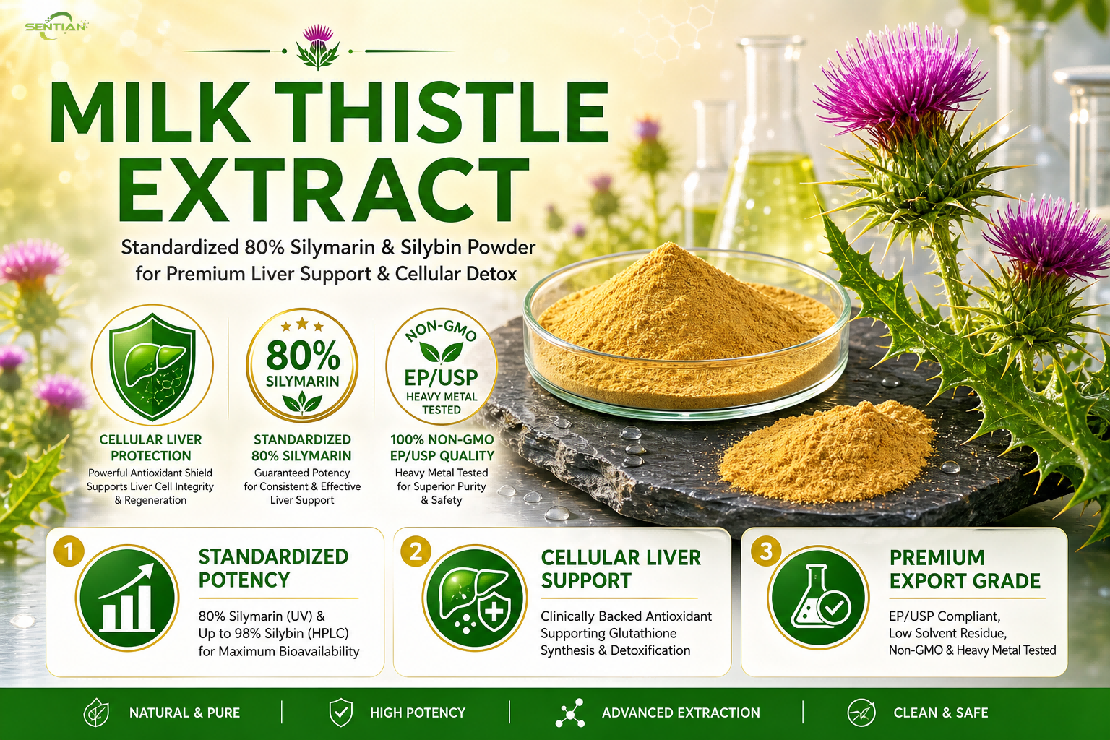

The main formulation characteristic of milk thistle extract is its silymarin content. Silymarin consists of several related flavonolignans, with silybin (also known as silibinin) representing one of its major constituents. Other components may include isosilybin, silychristin, and silydianin.
An 80% silymarin extract provides a defined total silymarin specification for ingredient selection and formulation calculations. UV analysis is commonly used to determine the overall silymarin content. However, UV results represent a total assay and do not independently establish the concentration of every individual flavonolignan.
HPLC provides a more detailed analytical profile by separating individual compounds. In particular, the analysis of silybin A and silybin B helps characterize the composition of the extract beyond its total silymarin value. These two compounds are stereoisomers and can be evaluated separately through an appropriate chromatographic method.
The 10:1 extract specification describes the concentration ratio between the starting plant material and the resulting extract. It provides information about the extraction ratio but does not independently define the silymarin concentration. Therefore, 10:1 extracts and 80% standardized extracts should be evaluated using different specification criteria.
From a formulation perspective, these differences influence ingredient selection, standardization calculations, and raw material documentation. Formulators should consider the intended silymarin contribution, extraction characteristics, powder properties, and compatibility with other botanical ingredients.

1. Dietary Supplements
Milk thistle extract is used as a botanical ingredient in capsules, tablets, powders, and other dietary supplement formats. The 80% silymarin specification is relevant when a formulation requires a defined level of total silymarin. The 10:1 extract provides an alternative specification for products formulated around botanical extract ratios.
When calculating the inclusion level of an 80% extract, formulators can use the declared silymarin assay as a reference. For example, the theoretical silymarin contribution is calculated by multiplying the extract weight by its silymarin percentage.
2. Liver Health Formulations
Milk thistle is commonly incorporated into botanical formulations positioned around liver health. It may be combined with other plant-derived ingredients according to the intended formulation design.
In these applications, the selection of a standardized extract can facilitate ingredient-level consistency and quantitative formulation control. The presence of silymarin should be documented through the relevant analytical method.
3. Functional Foods
Milk thistle extract can be considered for selected functional food applications, including powdered blends and other dry formulations. Its suitability depends on factors such as solubility, dispersion, taste, processing temperature, and compatibility with the food matrix.
Formulators should evaluate the finished product characteristics rather than relying exclusively on the extract's standardization percentage.
4. Botanical Combination Formulations
Milk thistle extract can be included in multi-ingredient botanical blends. In these products, the 80% silymarin extract offers a standardized input, while the 10:1 extract can be selected when the formulation is based on botanical extract ratios.
Ingredient documentation should clearly identify the extract type, botanical source, specification, and analytical method to avoid confusion between different milk thistle extract grades.
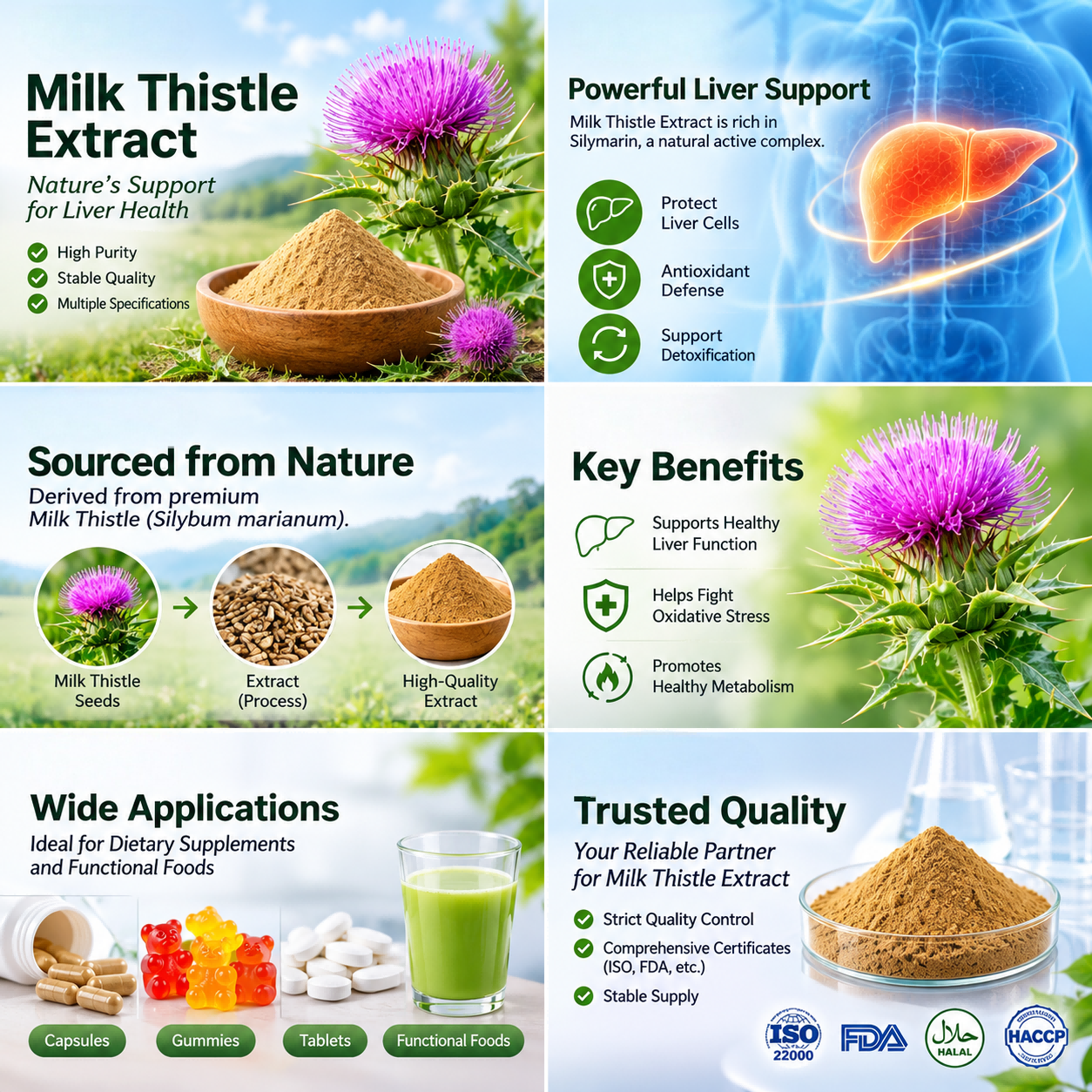

The chemical composition of milk thistle extract depends on the botanical raw material and extraction conditions. Silymarin is not a single chemical compound but a mixture of related flavonolignans. Consequently, the total silymarin assay and the individual compound profile provide different types of analytical information.
For an 80% silymarin extract, UV analysis is used to evaluate the declared total silymarin specification. This method is suitable for overall content determination within the defined analytical procedure. However, it should not be interpreted as an individual measurement of silybin A and silybin B.
HPLC analysis provides additional compositional information through chromatographic separation. The determination of silybin A and silybin B can support the characterization of the extract and provide a more detailed understanding of its constituent profile.
A comprehensive quality control program for milk thistle extract may include the following analytical categories:
Identity and assay: Confirmation of botanical identity and determination of total silymarin content.
HPLC analysis: Evaluation of individual constituents, including silybin A and silybin B.
Heavy metal testing: Assessment of relevant elemental contaminants.
Microbiological testing: Evaluation of applicable microbial parameters.
Residual solvent testing: Verification of residual extraction solvents against applicable requirements.
COA documentation: Recording of batch-specific analytical results and product specifications.
For B2B ingredient evaluation, the distinction between 80% silymarin extract and 10:1 milk thistle extract should remain clear throughout product specifications, technical documentation, and formulation records. A COA should identify the applicable assay method and report the corresponding analytical results.
These analytical parameters provide a basis for raw material assessment, batch comparison, and formulation standardization. Final acceptance criteria should be established according to the intended application and applicable regulatory requirements.
Product Categories : Raw Health Products > Plant Extract


Home > Products > Raw Health Products > Plant Extract > Milk Thistle Extract 80% Silymarin UV


Send Inquiry

Ms. Linda
Tel:
Fax:
Mobile Phone:+86 18602905487
Email:sales3@sentianbio.com
Address:Room 2002, Building B, Economic Development Building, Weiyang District, Xian, Shaanxi
Mobile Site

Privacy statement: Your privacy is very important to Us. Our company promises not to disclose your personal information to any external company with out your explicit permission.
Fill in more information so that we can get in touch with you faster
Privacy statement: Your privacy is very important to Us. Our company promises not to disclose your personal information to any external company with out your explicit permission.