


 Contact Now


Send Message
Privacy statement: Your privacy is very important to Us. Our company promises not to disclose your personal information to any external company with out your explicit permission.
Products


Model No.: ST-Trans-Resveratrol
Types Of: Herbal Extract
Traits: Powder
Location: Shell
Extraction Method: Liquid-Solid Extraction
Package: Bottle, Drum, Plastic Container
Place Of Origin: China
Product Name: Knotweed Trans-Resveratrol
Botanical Source: Polygonum cuspidatum
Plant Part: Root
Main Active Compound: Trans-Resveratrol
Product Form: Powder
Primary Specification: 98% Trans-Resveratrol
Alternative Specifications: 50%, 20% Trans-Resveratrol
Higher-Purity Option: 99% Trans-Resveratrol
Assay Method: HPLC
Isomer Identification: HPLC differentiation of trans- and cis-resveratrol
Appearance: Powder; specific appearance to be confirmed by product specification
Quality Documentation: Certificate of Analysis (COA)
Packaging: 25kgs packaging Fiber drum outside and plastic bag inside 1-25kgs packaging aluminium bag outside and double plastic bag inside.
Transportation: Ocean,Land,Air,Express
Supply Ability: 100000kg
Port: Shanghai,Qingdao,Beijing
Payment Type: T/T,Paypal
Incoterm: FOB,CIF,EXW,FCA,CIP,DDP,Express Delivery



Knotweed Trans-Resveratrol is a plant-derived polyphenol ingredient extracted from the root of Polygonum cuspidatum. Its primary active compound is trans-resveratrol, a naturally occurring stilbene belonging to the polyphenol family. This ingredient is used in dietary supplements, functional foods, powdered beverages, and selected cosmetic formulations.
Resveratrol exists in two major geometric isomer forms: trans-resveratrol and cis-resveratrol. These forms have different molecular configurations and should be distinguished during analytical testing when a product requires a specific trans-resveratrol concentration. HPLC analysis provides a method for identifying and quantifying the trans-isomer separately from the cis-isomer.
Knotweed Trans-Resveratrol is available in different concentration grades to accommodate varying formulation requirements. The 98% HPLC powder is the primary high-purity specification, while 50% and 20% trans-resveratrol extracts provide alternative options for applications requiring different active ingredient concentrations.
The 98% specification is suitable for manufacturers developing concentrated botanical ingredient formulations, particularly capsules, tablets, and softgels. Its defined active compound content allows formulation developers to calculate ingredient quantities more accurately and establish appropriate raw material quality standards.
In addition to active content, the evaluation of this ingredient may include heavy metal testing, microbiological limits, and residual solvent analysis. Batch-specific analytical documentation, including a Certificate of Analysis (COA), can support raw material inspection and quality management.
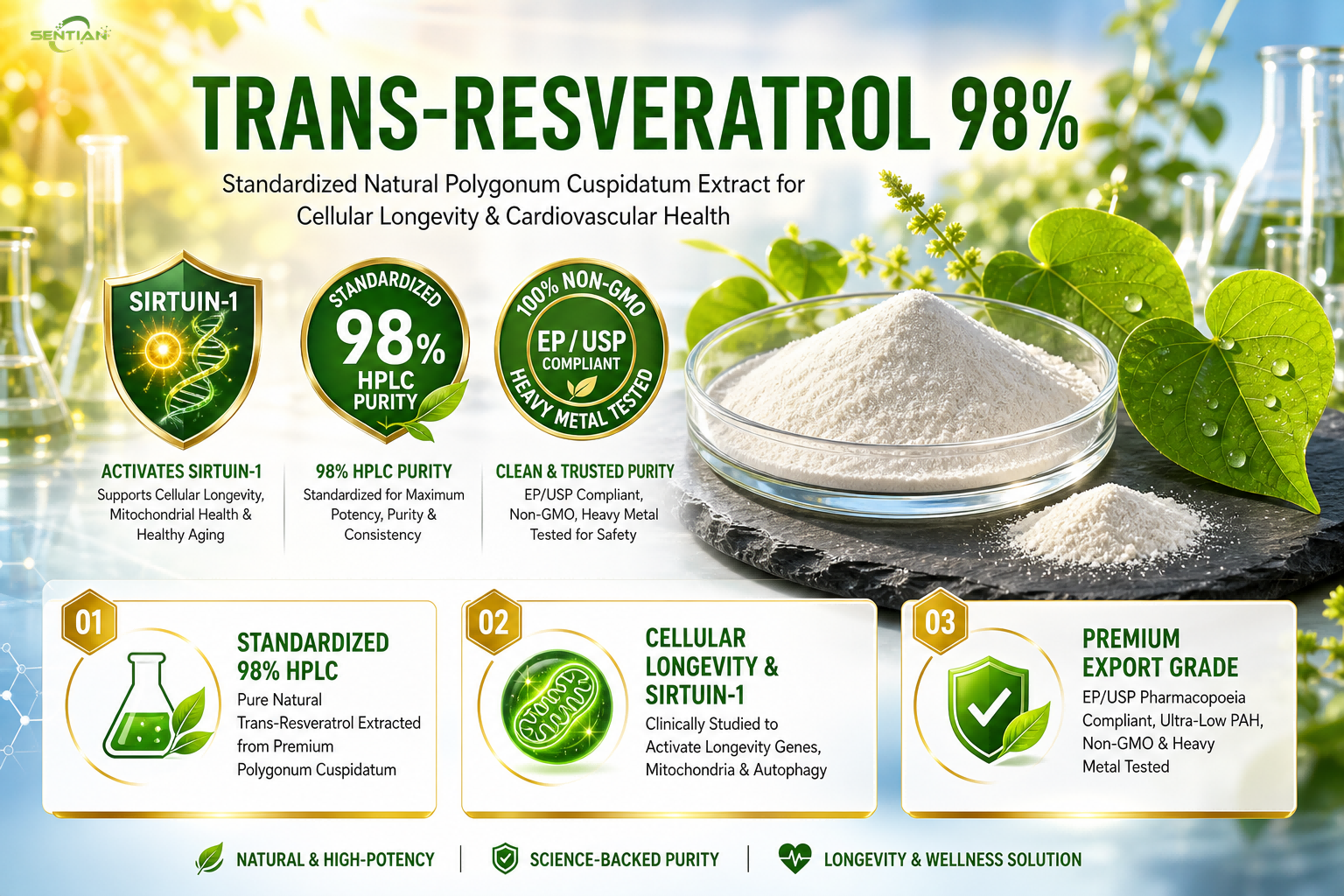

HPLC standardization is particularly important for resveratrol ingredients because total resveratrol content does not necessarily indicate the actual concentration of trans-resveratrol. The analytical method should distinguish the trans-isomer from cis-resveratrol and other potentially related compounds. This distinction helps ensure that the reported assay result corresponds to the specified active compound.
The 98% powder is intended for formulations requiring a high concentration of trans-resveratrol. Compared with lower-concentration extracts, high-purity powder requires a smaller quantity of raw material to provide an equivalent amount of the target compound. This characteristic can be relevant when manufacturers are developing concentrated capsules, tablets, and other supplement formats.
The 50% and 20% specifications provide additional formulation flexibility. These grades may be considered when a product requires a lower active concentration or when the formulation includes multiple botanical ingredients. The selection should take into account ingredient loading, formulation cost, processing conditions, and the target trans-resveratrol content.
Stability is another consideration during formulation development. Exposure to light, oxygen, temperature, and different processing environments may affect the stability of resveratrol-containing ingredients. Manufacturers should evaluate suitable packaging materials, storage conditions, and processing exposure when developing finished products.
The physical and chemical compatibility of the powder should also be assessed in the intended formulation system. Factors such as dispersion, solubility, excipient compatibility, and moisture exposure may influence processing performance and finished-product quality.

Dietary Supplements
Dietary supplements are an important application area for Knotweed Trans-Resveratrol. The 98% HPLC powder can be incorporated into capsule and tablet formulations where a concentrated, standardized polyphenol ingredient is required.
For softgel applications, the ingredient may be evaluated in suitable oil-based or suspension systems. Formulation developers should assess dispersion, compatibility with the carrier system, and physical stability during product development.
The 50% and 20% grades can provide alternative options for formulations with different active ingredient requirements. The appropriate specification should be selected according to the target trans-resveratrol content and the overall composition of the supplement.
Functional Foods
Knotweed Trans-Resveratrol can be considered for functional food formulations containing standardized polyphenol ingredients. The 98% grade offers a concentrated option, while lower-concentration extracts provide flexibility for products requiring different botanical ingredient loading levels.
Compatibility with the food matrix should be evaluated during formulation development. Processing temperature, moisture exposure, ingredient interactions, and storage conditions may influence the performance of the final product.
Solid Beverage Formulations
Trans-resveratrol can also be evaluated for powdered beverage formulations and functional drink premixes. When incorporating the ingredient into a solid beverage system, manufacturers should consider powder dispersion, processing compatibility, taste characteristics, and stability.
The high-purity 98% powder may require additional formulation work to achieve the desired dispersion characteristics. Appropriate excipients and processing methods should be selected according to the beverage formulation and manufacturing process.
Cosmetic Formulations
In cosmetic applications, Knotweed Trans-Resveratrol can be considered as a plant-derived polyphenol ingredient for selected skincare products, including serums and creams.
It may be incorporated into formulations developed around antioxidant-related skincare concepts and skin-aging care. However, formulation developers should evaluate its compatibility with the cosmetic base, solubility, stability, and packaging requirements.
For water-based products and emulsions, the selection of an appropriate delivery system is important. The ingredient's dispersion and stability should be assessed under the intended manufacturing and storage conditions.
 Knotweed Trans-Resveratrol is characterized by its botanical origin and standardized trans-resveratrol content. The 98% HPLC powder is the primary high-purity specification, while 99% HPLC is an additional option for applications requiring a higher assay level.
The 50% and 20% trans-resveratrol extracts offer alternative concentration grades. These products can be evaluated according to the required active content, formulation design, and raw material specifications. Their actual composition and assay results should be confirmed through batch-specific analytical testing.
HPLC is the primary analytical method for determining trans-resveratrol concentration. For products requiring specific isomer control, the analytical procedure should provide adequate separation and identification of trans-resveratrol and cis-resveratrol. This is important because the trans-isomer content should not be assumed to be equivalent to total resveratrol content.
Additional quality control parameters may include heavy metals, microbiological limits, and residual solvents. These tests provide information about different aspects of raw material quality and should be assessed against the applicable product specifications and regulatory requirements.
A batch-specific Certificate of Analysis (COA) should document the relevant analytical results, including trans-resveratrol content and applicable quality control parameters. Manufacturers can use this documentation for incoming material inspection, raw material qualification, and formulation records.
Selecting an appropriate specification requires consideration of the intended application, target active content, analytical requirements, and finished-product formulation. The 98% HPLC powder is suitable for concentrated trans-resveratrol formulations, while the 50% and 20% extracts provide additional options for products requiring different ingredient concentrations.
Product Categories : Raw Health Products > Plant Extract


Home > Products > Raw Health Products > Plant Extract > Knotweed Trans-Resveratrol 98% HPLC Powder


Send Inquiry

Ms. Linda
Tel:
Fax:
Mobile Phone:+86 18602905487
Email:sales3@sentianbio.com
Address:Room 2002, Building B, Economic Development Building, Weiyang District, Xian, Shaanxi
Related Products List
Mobile Site

Privacy statement: Your privacy is very important to Us. Our company promises not to disclose your personal information to any external company with out your explicit permission.
Fill in more information so that we can get in touch with you faster
Privacy statement: Your privacy is very important to Us. Our company promises not to disclose your personal information to any external company with out your explicit permission.