


 Contact Now


Send Message
Privacy statement: Your privacy is very important to Us. Our company promises not to disclose your personal information to any external company with out your explicit permission.
Products
Model No.: ST-Beta-Sitosterol
Types Of: Herbal Extract
Traits: Powder
Location: Bark, Leaf
Extraction Method: Liquid-Solid Extraction
Package: Bottle, Can, Drum
Product Name: Beta-Sitosterol 95% HPLC
Botanical Source: Glycine max (L.) Merr.
Plant Part Used: Seed
Raw Material: Soybean Oil Deodorizer Distillate
Appearance: White to off-white crystalline powder
Beta-Sitosterol Assay: ≥95.0% by HPLC, on a dry basis
CAS Number: 83-46-5
Molecular Formula: C29H50O
Molecular Weight: 414.71 g/mol
EINECS Number: 201-480-6
Melting Point: 136–140°C
Solubility: Practically insoluble in water; limited solubility in ethanol and acetone
Bulk Density: 0.3–0.6 g/mL
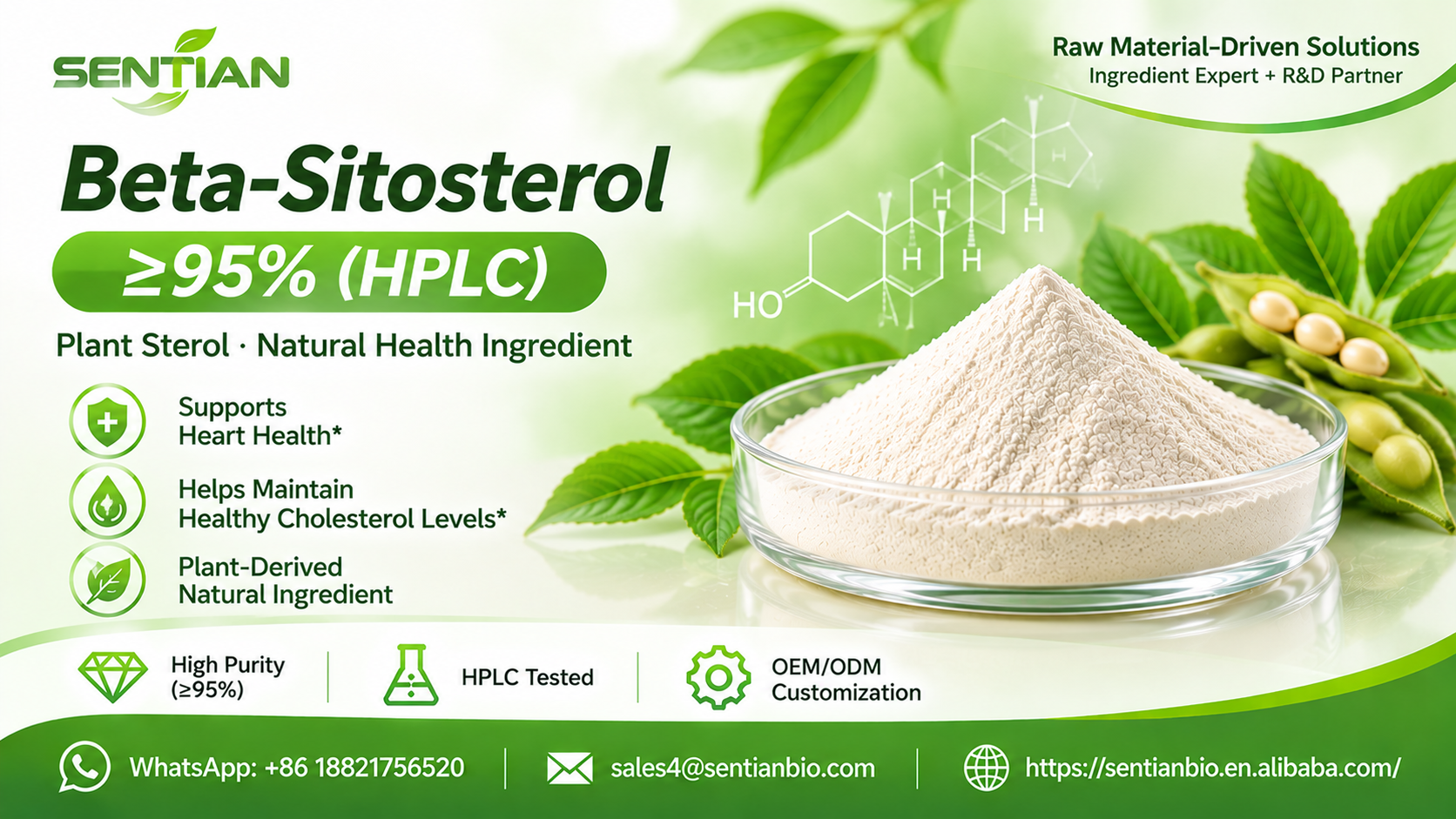
Beta-sitosterol is a naturally occurring plant sterol found in vegetable oils, seeds, nuts, and other plant materials. It belongs to the phytosterol group and has a chemical structure similar to cholesterol, with an additional ethyl group in its side chain. The ingredient is used in dietary supplement formulations, phytosterol blends, functional foods, and selected cosmetic products.
This product is a high-purity beta-sitosterol extract standardized to at least 95% by HPLC on a dry basis. It is obtained from soybean oil deodorizer distillate, a by-product of soybean oil refining. The botanical source is Glycine max (L.) Merr., and the plant part used is the seed. The finished ingredient is supplied as a white to off-white crystalline powder for food-grade or dietary supplement-grade applications.
The product specification also includes a total phytosterol content of at least 97% by GC-FID. Beta-sitosterol content and total phytosterol content are separate analytical parameters: the former measures the target sterol, while the latter represents the combined content of specified plant sterols.
| Parameter | Specification |
|---|---|
| Product Name | Beta-Sitosterol 95% HPLC |
| Botanical Source | Glycine max (L.) Merr. |
| Plant Part Used | Seed |
| Raw Material | Soybean Oil Deodorizer Distillate |
| Appearance | White to off-white crystalline powder |
| Beta-Sitosterol Assay | ≥95.0% by HPLC, on a dry basis |
| Total Phytosterols | ≥97.0% by GC-FID |
| CAS Number | 83-46-5 |
| Molecular Formula | C29H50O |
| Molecular Weight | 414.71 g/mol |
| EINECS Number | 201-480-6 |
| Melting Point | 136–140°C |
| Solubility | Practically insoluble in water; limited solubility in ethanol and acetone |
| Particle Size | ≥95% passing through 80 mesh |
| Optional Particle Size | 100 mesh, 200 mesh, or micronized grade ≤30 μm |
| Bulk Density | 0.3–0.6 g/mL |
| Loss on Drying | ≤3.0%; high-purity specification may be ≤1.0% |
| Residue on Ignition | ≤1.0% |
| Storage | Store tightly sealed in a cool, dry place, protected from light, at ≤25°C |
| Shelf Life | 24–36 months, subject to validated product specifications |
Beta-sitosterol is structurally similar to cholesterol. In the digestive tract, plant sterols can compete with cholesterol for incorporation into mixed micelles, potentially reducing the amount of dietary and biliary cholesterol available for intestinal absorption. This mechanism provides the scientific basis for using phytosterols in cholesterol-management formulations. The effect depends on the total phytosterol intake, formulation, dietary context, and individual response; it should not be interpreted as a treatment claim for the isolated ingredient.
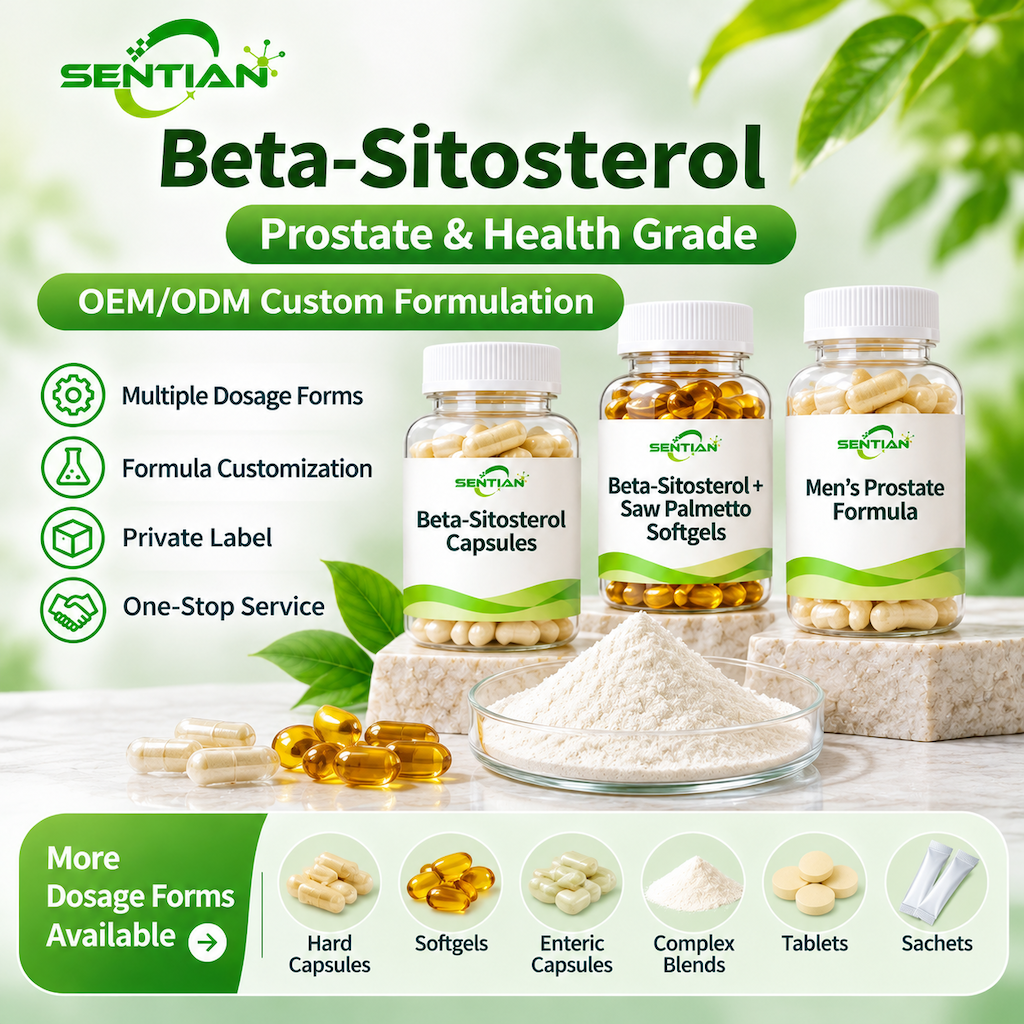
Beta-sitosterol is also studied in relation to prostate health and lower urinary tract symptoms. Research has examined its potential influence on urinary symptom scores and flow-related measures in men with benign prostatic hyperplasia. Evidence from studies of beta-sitosterol-containing preparations does not establish that every high-purity ingredient or finished formulation will produce the same outcome. Product descriptions should therefore distinguish nutritional use from medical treatment claims.
As a lipophilic sterol, beta-sitosterol has limited compatibility with water-based systems. Its low water solubility affects dispersion, processing, and delivery. Micronization can improve powder handling and distribution within suitable solid or oil-based formulations, but it does not make the ingredient intrinsically water-soluble. For beverage and aqueous applications, formulators may need an appropriate dispersion system or a compatible phytosterol derivative rather than assuming that the crystalline powder will dissolve.
The ingredient can be combined with other plant sterols to create phytosterol blends with defined sterol profiles. It may also be included in prostate-health formulations alongside botanical ingredients such as saw palmetto (Serenoa repens) or African plum (Pygeum africanum). The role of each component should be assessed according to the intended product category, formulation evidence, and applicable regulatory requirements.
In dietary supplements, beta-sitosterol 95% HPLC can be used in capsules, tablets, and softgel formulations. For tablets, particle size and powder flow are relevant to blending and compression. A micronized grade may be considered when a finer particle distribution is needed. In softgels, the ingredient may be incorporated as a suitable oil suspension, subject to compatibility and stability assessment.
For prostate-health products, beta-sitosterol is sometimes combined with saw palmetto, African plum, and other ingredients used in men's health formulations. These combinations should be developed with attention to the evidence available for the complete formulation, rather than attributing the effects of a multi-ingredient product to beta-sitosterol alone.
In cardiovascular and cholesterol-management products, beta-sitosterol may be included in broader phytosterol blends or nutritional formulations. It can also be used in fortified food concepts, including nutrition powders, meal-replacement products, solid beverages, compressed confectionery, and selected oil- or dairy-based foods. Because the crystalline ingredient has very low water solubility, the processing method and final food matrix need to be considered during product development.
Cosmetic applications include selected skin-conditioning and barrier-support formulations. Beta-sitosterol or phytosterol blends may be incorporated into creams and lotions with ingredients such as ceramides and squalane. Compatibility with the oil phase, emulsion structure, and intended INCI declaration should be reviewed before commercial formulation.
High-purity beta-sitosterol may also serve as a starting material in certain steroid-related chemical synthesis routes. Such use is distinct from food, supplement, or cosmetic applications and requires separate assessment of material grade, process controls, and regulatory status.
The main standardization parameter is beta-sitosterol at not less than 95.0% by HPLC on a dry basis. Depending on the analytical method, HPLC-UV at 210 nm or HPLC-ELSD may be used. GC-FID following trimethylsilyl derivatization is another possible approach for sterol analysis. The method, reference standard, calculation basis, and reporting convention should be defined in the product specification to ensure that results from different methods are not treated as directly interchangeable.
Total phytosterols are specified at not less than 97.0% by GC-FID. A sterol profile may be used to characterize beta-sitosterol alongside campesterol, stigmasterol, brassicasterol, and other relevant sterol components. The profile should be reported as measured rather than inferred from the beta-sitosterol assay.
Additional quality parameters may include heavy metals by ICP-MS, pesticide residues by GC-MS/MS and LC-MS/MS, residual solvents by headspace GC, and microbiological limits. The proposed heavy-metal limits are lead ≤1 ppm, arsenic ≤1 ppm, cadmium ≤1 ppm, and mercury ≤0.1 ppm. Microbiological criteria should specify total plate count and the applicable limits for yeast, mold, and indicator or pathogenic organisms. Pesticide and residual-solvent requirements should be aligned with the destination market and the relevant regulatory or customer standards.
Batch documentation may include a certificate of analysis, safety data sheet, technical data sheet, non-GMO statement, and allergen statement. The COA should identify the botanical source as Glycine max (L.) Merr. and the plant part used as seed. Storage conditions, packaging, and shelf-life claims should be supported by the applicable stability data.
Product Categories : Raw Health Products > Plant Extract


Home > Products > Raw Health Products > Plant Extract > Beta-Sitosterol 95% HPLC Soybean Extract


Send Inquiry

Ms. Linda
Tel:
Fax:
Mobile Phone:+86 18602905487
Email:sales3@sentianbio.com
Address:Room 2002, Building B, Economic Development Building, Weiyang District, Xian, Shaanxi
Mobile Site

Privacy statement: Your privacy is very important to Us. Our company promises not to disclose your personal information to any external company with out your explicit permission.
Fill in more information so that we can get in touch with you faster
Privacy statement: Your privacy is very important to Us. Our company promises not to disclose your personal information to any external company with out your explicit permission.