


 Contact Now


Send Message
Privacy statement: Your privacy is very important to Us. Our company promises not to disclose your personal information to any external company with out your explicit permission.
Products
Model No.: ST- Konjac Glucomannan
Types Of: Herbal Extract
Traits: Powder
Location: Bark
Extraction Method: Liquid-Solid Extraction
Package: Bottle, Can, Drum
Product Name: Konjac Glucomannan (KGM)
Botanical Source: Amorphophallus konjac tuber
Grade: Food Grade / Dietary Supplement Ingredient Grade
Glucomannan Content: 90% / 95% / 98% (dry basis)
Recommended Specification: 95% high-viscosity grade
CAS Number: 37220-17-0
Appearance: White to off-white fine powder
Particle Size: 80 / 100 / 120 / 200 mesh
Solubility: Dispersible in cold water; forms a viscous colloidal solution
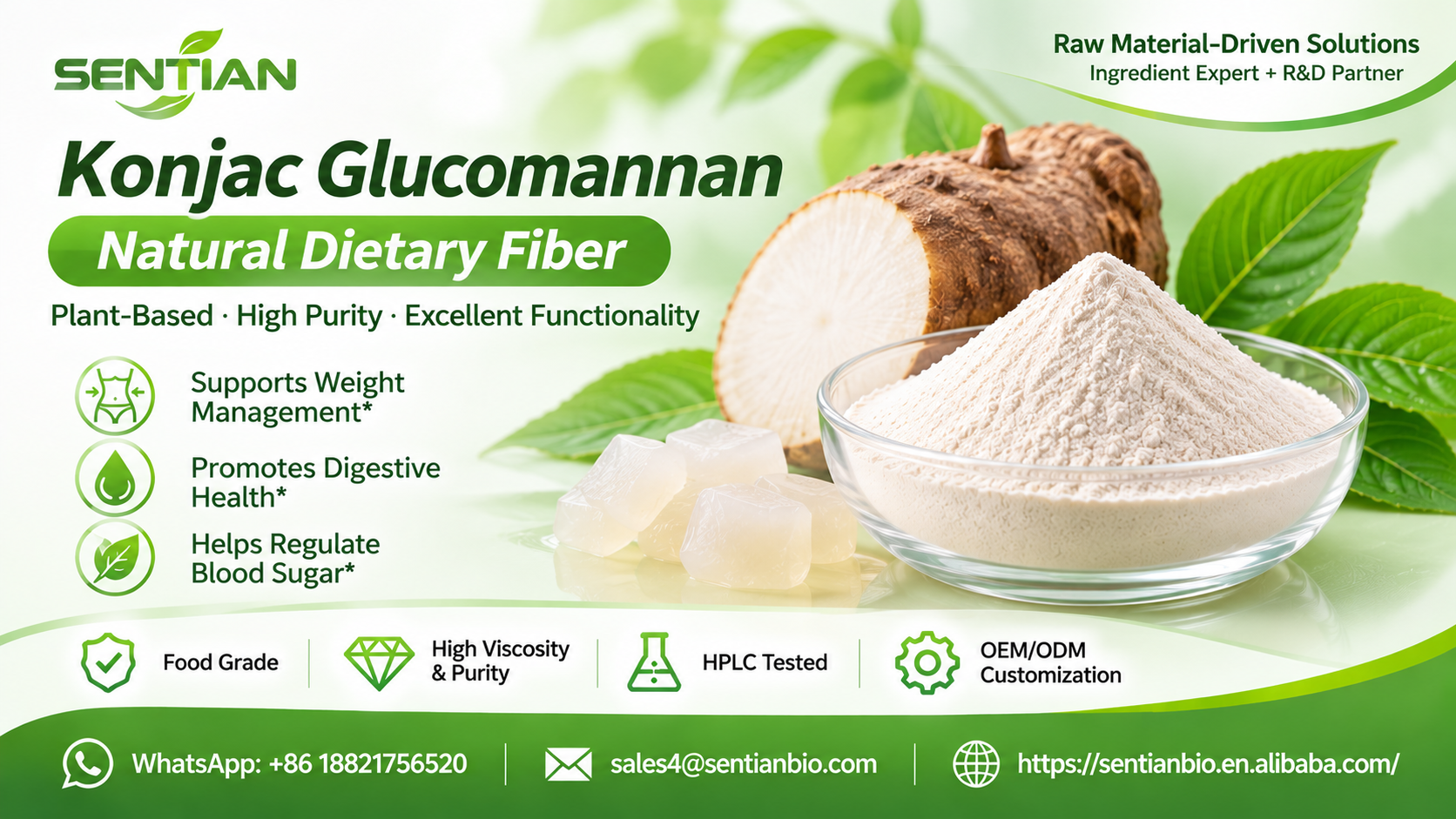
Konjac Glucomannan (KGM) is a natural soluble dietary fiber derived from the tuber of Amorphophallus konjac. It is composed primarily of glucomannan polysaccharides, featuring a backbone of D-mannose and D-glucose units connected through β-1,4 glycosidic bonds, with some acetyl groups contributing to its physicochemical properties. Konjac glucomannan is recognized for its water-binding capacity, swelling behavior, and ability to form viscous aqueous solutions.
Commercial konjac glucomannan powder is produced through processing steps such as cleaning, slicing, drying, milling, purification, and impurity removal. The resulting ingredient can be standardized to different glucomannan concentrations, depending on the intended application. Typical commercial specifications include 90%, 95%, and 98% glucomannan on a dry basis. The 95% grade is commonly selected for dietary supplement formulations requiring a concentrated soluble fiber ingredient.
Konjac glucomannan is distinct from ordinary konjac flour, which may contain higher proportions of other plant components and lower glucomannan concentrations. Purified KGM powder is used in supplement, food, and formulation applications where fiber concentration, viscosity, dispersion behavior, and texture modification are relevant technical parameters.
| Parameter | Specification |
|---|---|
| Product Name | Konjac Glucomannan (KGM) |
| Botanical Source | Amorphophallus konjac tuber |
| Grade | Food Grade / Dietary Supplement Ingredient Grade |
| Glucomannan Content | 90% / 95% / 98% (dry basis) |
| Recommended Specification | 95% high-viscosity grade |
| CAS Number | 37220-17-0 |
| Molecular Formula | Polysaccharide; no single fixed molecular formula |
| Molecular Weight | Approximately 200,000–2,000,000 Da |
| Structural Composition | D-mannose and D-glucose units linked by β-1,4 glycosidic bonds |
| Appearance | White to off-white fine powder |
| Particle Size | 80 / 100 / 120 / 200 mesh |
| Solubility | Dispersible in cold water; forms a viscous colloidal solution |
| Water Absorption | High water-binding and swelling capacity; application-dependent |
| Viscosity | Common specifications: ≥20,000 / ≥30,000 / ≥40,000 mPa·s |
| Moisture | ≤10.0% |
| Ash | ≤4.0% |
| pH | 5.0–7.0 (1% suspension) |
| Viscosity Testing | Rotational viscometer at 25°C, 1% solution |
| Content Testing | HPLC |
| Storage | Sealed, cool, dry, ventilated conditions; protect from moisture and heat |
| Shelf Life | 24 months under specified unopened storage conditions |
| Packaging | 1 kg aluminum foil bag; 25 kg drum with double PE liner |
Konjac glucomannan is a water-soluble polysaccharide with a high molecular weight and strong water-binding capacity. Its polymer structure enables it to absorb water and increase the viscosity of aqueous systems. When dispersed in water, KGM hydrates gradually and forms a viscous colloidal solution, making it relevant to formulations requiring thickening, stabilization, and texture modification.
As a soluble dietary fiber, glucomannan can absorb water within the digestive tract and form a viscous matrix. Research has investigated how this viscosity may influence gastric emptying, nutrient movement through the digestive tract, and satiety-related responses. These properties are relevant to dietary fiber formulations designed to support satiety and normal gastrointestinal function. However, the extent of these effects depends on dosage, formulation, individual physiological conditions, and consumption patterns.
KGM viscosity is an important technical characteristic. Viscosity measurements may help assess hydration behavior and the performance of different grades in formulation development. Higher viscosity does not automatically establish superior nutritional outcomes, as application performance also depends on dispersion, processing conditions, concentration, and compatibility with other ingredients.
Konjac glucomannan also exhibits gel-forming behavior under specific conditions. In alkaline environments, deacetylation can facilitate gel formation, potentially producing heat-irreversible gels. This property is relevant to konjac-based gel foods and selected food texture systems.
Konjac glucomannan powder is used in dietary supplements, functional foods, and food processing as a soluble dietary fiber and functional polysaccharide. In supplement applications, it can be incorporated into HPMC vegetable capsules, fiber blends, and selected powder-based formulations intended to support satiety and dietary fiber intake. Product design should consider hydration behavior, capsule capacity, dosage form, and consumer instructions.
Meal replacement powders, solid beverages, and calorie-conscious powdered formulations may use KGM as a fiber component. Its water-binding and thickening properties can influence mouthfeel, suspension stability, and the texture of reconstituted products. Dispersion and hydration conditions are important during processing to minimize clumping.
In food applications, konjac glucomannan is used in konjac jelly, pudding, plant-based gel foods, meat analogues, bakery products, sauces, salad dressings, noodles, and konjac rice products. Depending on formulation requirements, it may contribute to viscosity, moisture retention, texture modification, and stabilization. Its compatibility with other hydrocolloids should be assessed to optimize the final texture and processing behavior.
KGM may also be incorporated into fiber-based combination supplements containing ingredients such as white kidney bean extract, chitosan, cactus extract, or other dietary fibers. Cosmetic-grade konjac derivatives may be used in personal care formulations for thickening and moisture-related functions, subject to separate ingredient specifications and regulatory requirements.
Konjac glucomannan is a dietary fiber ingredient rather than a medicinal product. Adequate water intake is important when consuming glucomannan-containing products. Individuals with swallowing difficulties, esophageal narrowing, or a risk of intestinal obstruction should seek medical advice before use. Pregnant or lactating individuals should also consult a healthcare provider.
Konjac glucomannan is primarily standardized according to its glucomannan content on a dry basis. Common commercial grades include 90%, 95%, and 98%, with the 95% high-viscosity grade frequently used in dietary supplement formulations. Content analysis may be conducted using HPLC, subject to the analytical method and sample preparation procedure.
Viscosity is another important specification and is commonly evaluated using a rotational viscometer at 25°C with a 1% aqueous solution. Commercial viscosity specifications may include 20,000, 30,000, or 40,000 mPa·s or higher, depending on the grade and measurement conditions. Viscosity values should be compared only when testing conditions are consistent.
Additional quality parameters may include particle size, moisture, ash, pH, heavy metals, microbial limits, pesticide residues, and residual sulfur dioxide. Heavy metals such as lead, arsenic, cadmium, and mercury may be assessed using ICP-MS. Microbiological testing may include total plate count, yeast and mold, Escherichia coli, Salmonella, and Staphylococcus aureus, depending on applicable standards.
Batch documentation may include a Certificate of Analysis (COA), Technical Data Sheet (TDS), and Material Safety Data Sheet (MSDS). Manufacturing certifications may include GMP, ISO 22000, Halal, or Kosher, depending on the facility and product. Allergen-related documentation may identify konjac and any relevant cross-contact considerations.
Product Categories : Raw Health Products > Plant Extract


Home > Products > Raw Health Products > Plant Extract > Konjac Glucomannan Powder 95% High Viscosity Soluble Dietary Fiber Konjac Glucomannan


Send Inquiry

Ms. Linda
Tel:
Fax:
Mobile Phone:+86 18602905487
Email:sales3@sentianbio.com
Address:Room 2002, Building B, Economic Development Building, Weiyang District, Xian, Shaanxi
Privacy statement: Your privacy is very important to Us. Our company promises not to disclose your personal information to any external company with out your explicit permission.
Fill in more information so that we can get in touch with you faster
Privacy statement: Your privacy is very important to Us. Our company promises not to disclose your personal information to any external company with out your explicit permission.