


 Contact Now


Send Message
Privacy statement: Your privacy is very important to Us. Our company promises not to disclose your personal information to any external company with out your explicit permission.
Products


Model No.: ST-Matcha Powder
Types Of: Tea Extract
Traits: Powder
Location: Leaf
Extraction Method: Liquid-Solid Extraction
Place Of Origin: China
Product Name: Matcha Powder
Botanical Source: Camellia sinensis
Product Grade: Food Grade
Appearance: Fine Green Powder
Total Tea Polyphenols: Tested by quantitative analysis
EGCG Content: Tested by HPLC
Caffeine Content: Tested by quantitative analysis
Moisture Content: Tested
Documentation: Batch-specific quality records
Transportation: Ocean,Land,Air,Express
Supply Ability: 100000kgs
Port: Shanghai,Beijing,Qingdao
Payment Type: T/T,Paypal
Incoterm: FOB,Express Delivery,EXW,FCA,DDP



Matcha Powder is a finely milled green tea powder produced from specially cultivated tea leaves (Camellia sinensis). Unlike conventional green tea, which is typically prepared by steeping tea leaves in hot water and removing the leaves before consumption, matcha is incorporated directly into food and beverage formulations in powdered form. This allows the entire powdered tea material to become part of the finished product.
Food Grade Matcha Powder is used as a botanical ingredient in solid beverages, bakery products, tea drinks, dairy-based formulations, and dietary supplements. Its characteristic green color, distinctive tea flavor, and naturally occurring tea constituents make it suitable for products requiring a recognizable green tea ingredient.
The chemical composition of matcha powder is influenced by tea cultivar, cultivation conditions, harvesting stage, processing methods, and storage conditions. These factors can affect its polyphenol profile, epigallocatechin gallate (EGCG) content, caffeine level, moisture content, color, and particle size.
For industrial formulation, matcha powder is generally evaluated through a combination of physical, chemical, and microbiological testing. Analytical parameters such as total tea polyphenols, EGCG, caffeine, moisture, and particle size help characterize the ingredient and assess its suitability for different product applications.
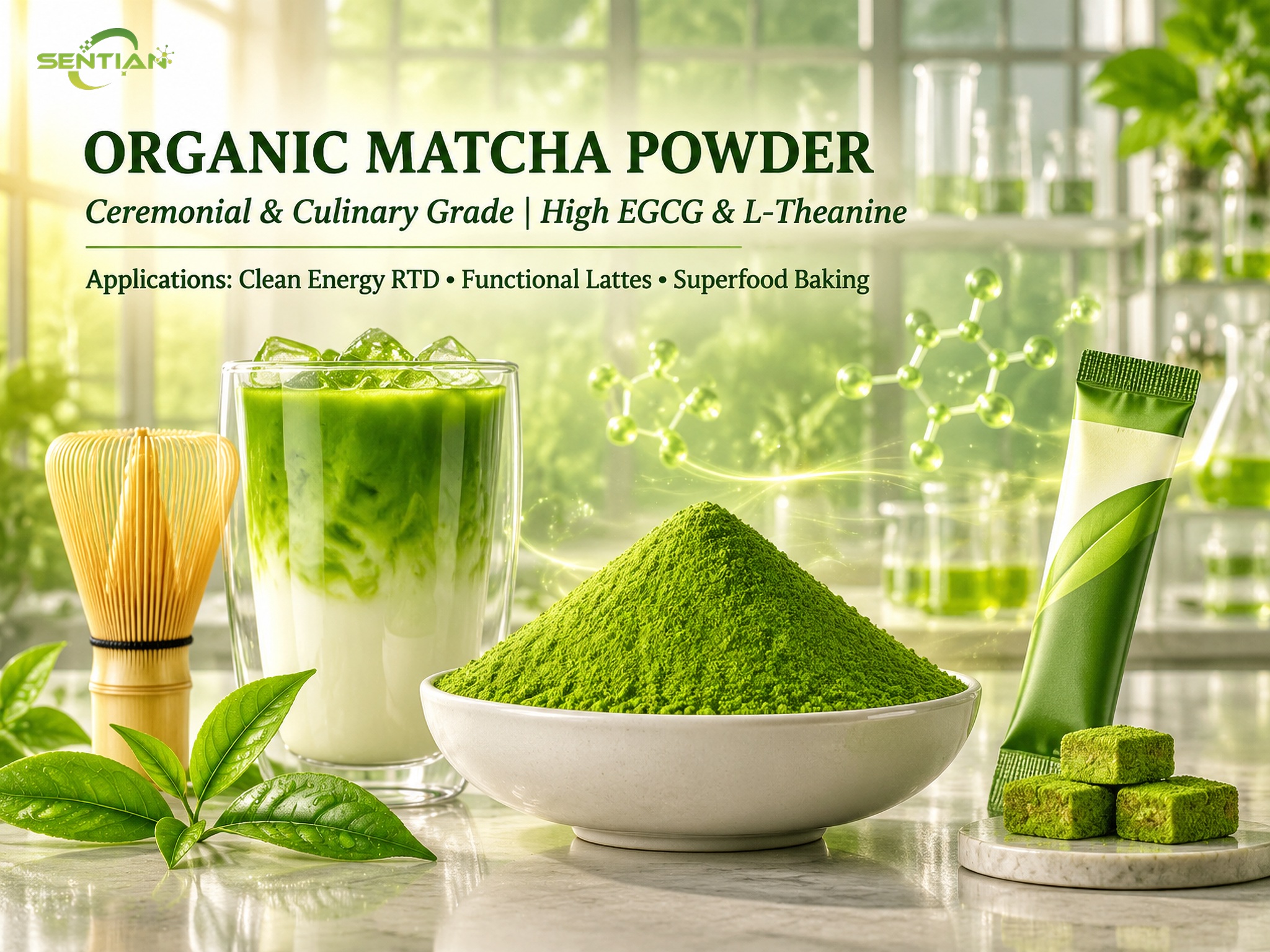

Food Grade Matcha Powder has several physical and compositional characteristics that influence its performance in food and beverage systems.
Natural Green Color
Matcha contains naturally occurring chlorophyll and other plant pigments that contribute to its green appearance. Its color can vary depending on cultivation, harvesting, processing, and storage conditions. In food formulations, it can provide a recognizable green tea appearance without requiring an additional synthetic colorant, subject to the formulation's color stability requirements.
Tea Polyphenols and EGCG
Tea polyphenols are an important group of naturally occurring compounds in green tea. EGCG is one of the major catechins found in tea leaves and is commonly used as an analytical marker when characterizing green tea ingredients.
The measured concentrations of total tea polyphenols and EGCG provide useful information about the chemical composition of matcha powder. These values are affected by raw material characteristics and processing conditions. For formulation development, analytical results should be considered alongside flavor, color, and processing requirements.
Caffeine Content
Matcha naturally contains caffeine. Its concentration depends on the tea material and manufacturing process. Caffeine analysis is particularly relevant when matcha powder is incorporated into dietary supplements, functional beverages, and products intended for consumers who monitor their caffeine intake.
Powder Characteristics
Particle size and moisture content are important physical quality indicators. Particle size can influence dispersion, texture, mouthfeel, and blending uniformity. Moisture content is relevant to powder handling, storage stability, and the prevention of moisture-related quality changes.
As a botanical powder, matcha may show differences in dispersion behavior compared with fully water-soluble ingredients. Formulation trials are therefore useful for determining the appropriate mixing sequence, liquid conditions, and processing parameters.

Food Grade Matcha Powder can be incorporated into different food and beverage categories according to product positioning, flavor requirements, and processing conditions.
1. Solid Beverage Formulations
Matcha powder is used in powdered beverage blends, instant drink mixes, and green tea beverage bases. It can be combined with sweeteners, milk powders, plant-based ingredients, and other functional components. Particle size and moisture content are relevant to blending uniformity, powder flow, and finished-product consistency.
2. Bakery Products
In bakery applications, matcha powder can be incorporated into cakes, cookies, biscuits, bread, pastries, and dessert mixes. It contributes green tea flavor and color to the finished product. Formulation developers should consider the effects of baking temperature, processing time, ingredient interactions, and storage conditions on color and flavor retention.
3. Tea Drinks and Dairy Products
Matcha is suitable for tea beverages, milk tea, matcha lattes, flavored milk, yogurt products, and other dairy-based formulations. Its distinctive flavor can be combined with dairy proteins, milk ingredients, sweeteners, and flavoring systems. Dispersion and suspension behavior should be evaluated to achieve the desired beverage texture and appearance.
4. Dietary Supplements
Matcha powder can serve as a botanical ingredient in capsules, tablets, powder blends, and other dietary supplement formats. In these applications, tea polyphenols, EGCG, and caffeine are relevant analytical parameters. Ingredient identity, contaminant testing, and batch consistency should also be considered during raw material evaluation.
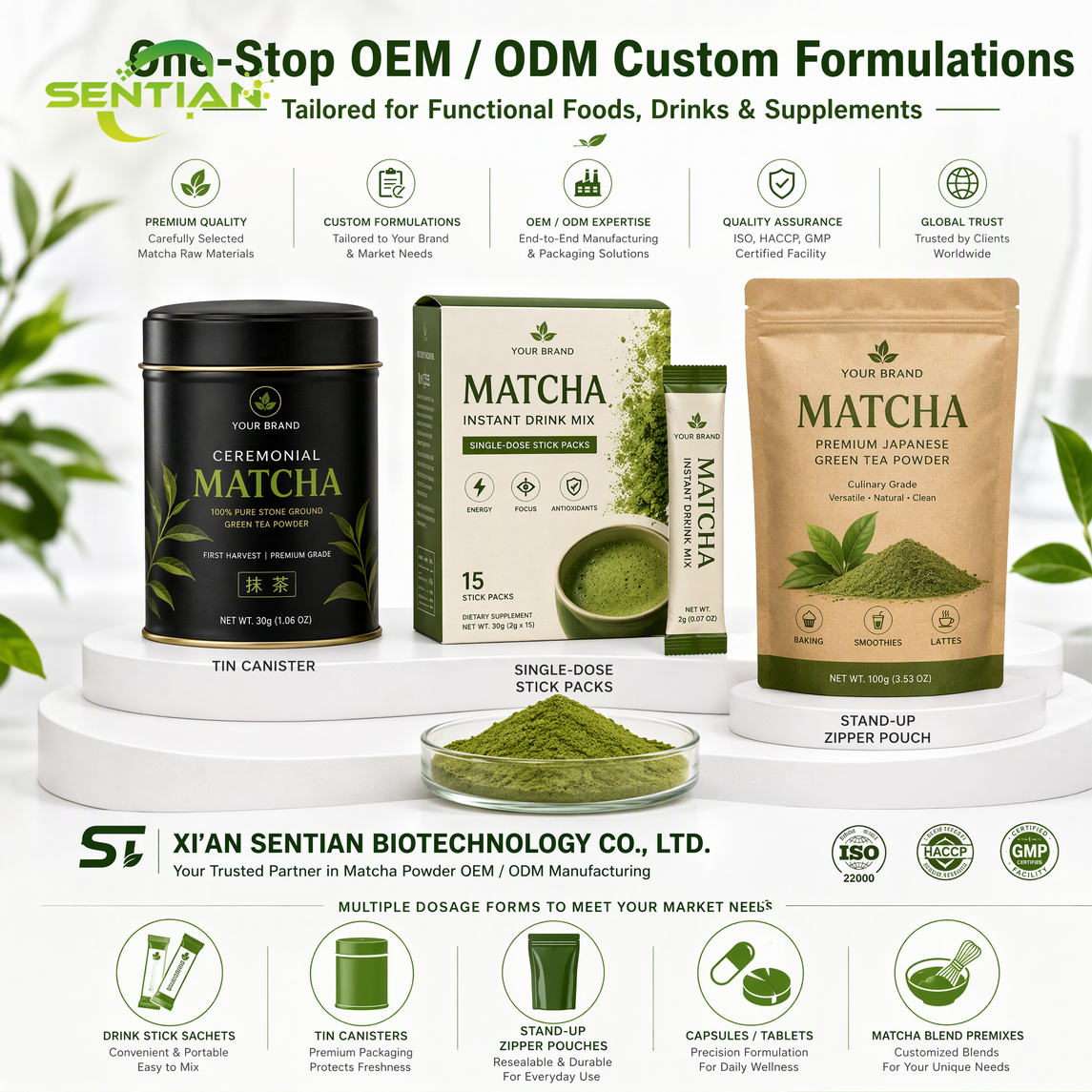

Matcha powder is a complex botanical food ingredient rather than a single isolated compound. Its composition includes naturally occurring tea polyphenols, catechins, caffeine, amino acids, chlorophyll, carbohydrates, and other constituents present in tea leaves.
Unlike standardized botanical extracts, conventional matcha powder is not necessarily manufactured to contain a fixed percentage of one active compound. Its composition can vary according to the tea cultivar, cultivation environment, harvesting conditions, and production process.
For B2B ingredient evaluation, standardization can be approached through defined analytical specifications rather than assuming a universal active ingredient concentration. Total tea polyphenols, EGCG, and caffeine are useful parameters for characterizing the chemical profile of individual batches.
Physical quality indicators, including moisture content and particle size, should also be incorporated into the product specification. In addition, heavy metal, pesticide residue, and microbiological testing help evaluate ingredient quality and compliance with applicable food safety requirements.
A batch-specific Certificate of Analysis (COA) provides documented analytical results for the tested material. Depending on the quality control program, it may include botanical identification, appearance, chemical composition, physical properties, contaminant results, and microbiological information.
For manufacturers developing food and beverage products, reviewing the COA together with the technical specification helps determine whether Food Grade Matcha Powder meets the requirements of the intended formulation, processing method, and target market.
Product Categories : Raw Health Products > Plant Extract


Home > Products > Raw Health Products > Plant Extract > Food Grade Matcha Powder for Food and Beverage Applications


Send Inquiry

Ms. Linda
Tel:
Fax:
Mobile Phone:+86 18602905487
Email:sales3@sentianbio.com
Address:Room 2002, Building B, Economic Development Building, Weiyang District, Xian, Shaanxi
Mobile Site

Privacy statement: Your privacy is very important to Us. Our company promises not to disclose your personal information to any external company with out your explicit permission.
Fill in more information so that we can get in touch with you faster
Privacy statement: Your privacy is very important to Us. Our company promises not to disclose your personal information to any external company with out your explicit permission.