


 Contact Now


Send Message
Privacy statement: Your privacy is very important to Us. Our company promises not to disclose your personal information to any external company with out your explicit permission.
Products
Model No.: ST- L-Glutathione
Product Name: Reduced L-Glutathione
Abbreviation: GSH
CAS Number: 70-18-8
Molecular Formula: C₁₀H₁₇N₃O₆S
Molecular Weight: 307.33 g/mol
Assay: 99% HPLC
Grade: Food Grade / Dietary Supplement Grade
Appearance: White crystalline powder
Supporting Documents: COA, MSDS, and TDS
Packaging: 25 kg drum with an inner aluminum foil bag; 100 g and 500 g sample packs available
Packaging: 1kg packaging aluminium bag outside and double plastic bag inside
Transportation: Ocean,Land,Air,Express
Supply Ability: 10000kg/months
Port: Shanghai,Qingdao


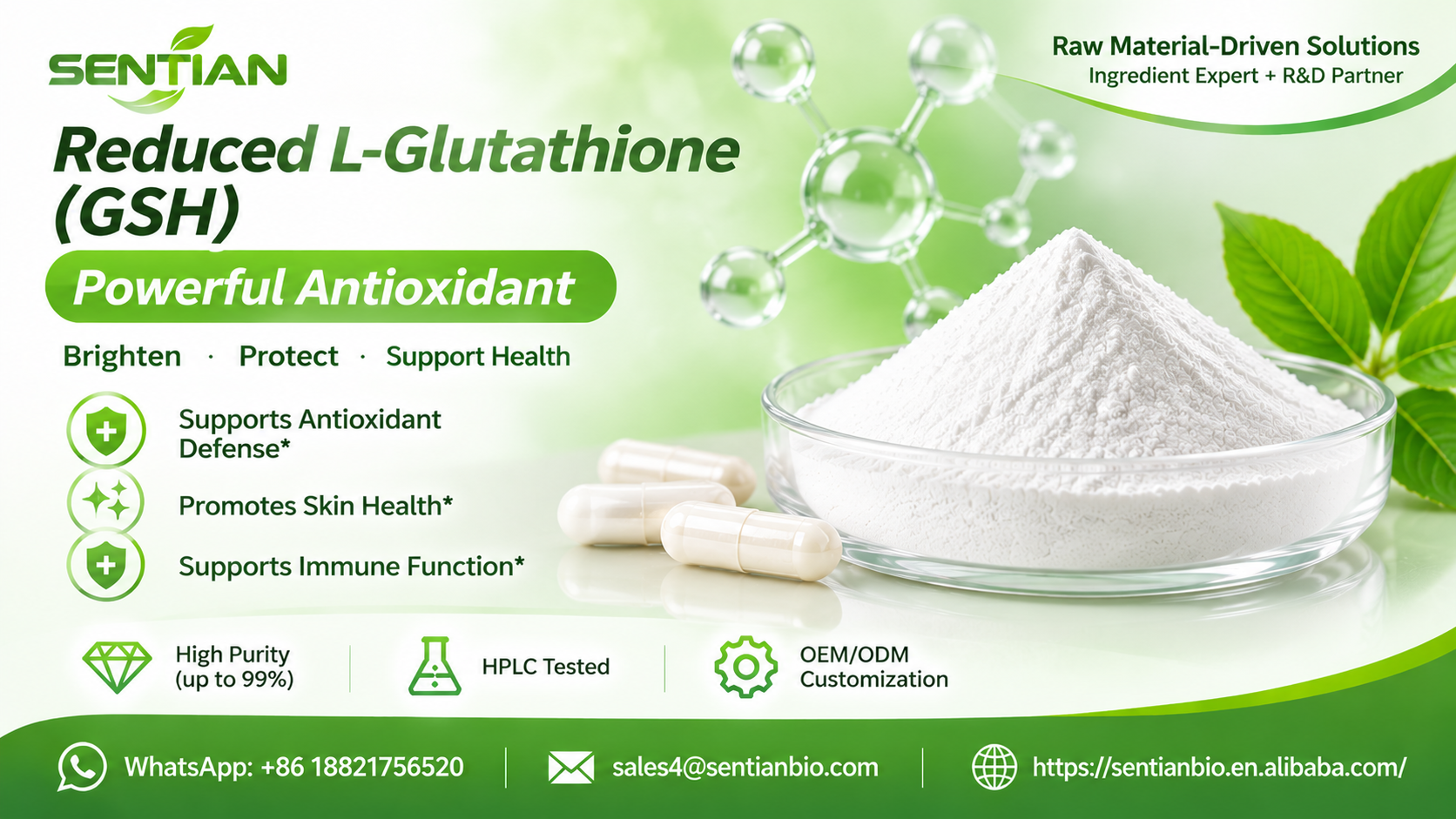
Reduced L-Glutathione (GSH) is a naturally occurring tripeptide composed of glutamic acid, cysteine, and glycine. It is present in many biological systems and plays an important role in cellular redox balance and antioxidant defense. Its reduced form contains a reactive sulfhydryl group (-SH), which enables it to participate in oxidation-reduction reactions and interact with reactive compounds.
In ingredient applications, Reduced L-Glutathione is primarily used in dietary supplements, beauty nutrition formulations, antioxidant blends, functional foods, and selected topical skincare products. It is commonly supplied as a white crystalline powder with a high water solubility profile, making it suitable for different formulation formats.
Commercial specifications may include 98% and 99% HPLC grades. The ingredient is available in food-grade and dietary supplement-grade options. Oxidized L-Glutathione (GSSG) is a related but chemically distinct form and may be considered as an alternative ingredient depending on formulation objectives.
The primary biochemical function of Reduced L-Glutathione is associated with its role in cellular antioxidant systems. Its cysteine residue provides a sulfhydryl group that can participate in redox reactions. During these reactions, reduced glutathione may be oxidized to glutathione disulfide (GSSG). Cellular enzymes, particularly glutathione reductase, help convert GSSG back to GSH using reducing equivalents supplied by NADPH.
This reversible relationship between GSH and GSSG is an important component of intracellular redox regulation. Glutathione also serves as a substrate for glutathione peroxidases, which help reduce hydrogen peroxide and certain lipid hydroperoxides. In addition, glutathione S-transferases use glutathione in the conjugation of various electrophilic compounds, supporting cellular metabolic and detoxification pathways.
These biochemical functions explain why GSH is studied in relation to oxidative stress, cellular protection, and skin biology. However, the physiological role of glutathione should not be interpreted as proof that oral or topical supplementation produces a specific clinical outcome. Absorption, metabolism, dosage, formulation, and individual physiological conditions can influence the effects of an administered ingredient.
From a formulation perspective, GSH offers several practical characteristics. Its water solubility supports incorporation into aqueous mixtures and instant powder systems. It can be used as a single active ingredient or combined with other nutritional components in multi-ingredient formulations. Because the reduced form contains a reactive sulfhydryl group, oxidation during processing and storage is an important consideration. Formulators should evaluate moisture exposure, oxygen contact, temperature, pH, and compatibility with other ingredients.
Reduced L-Glutathione is used in several categories of ingredient formulations.
Dietary supplement capsules and tablets: GSH powder can be incorporated into single-ingredient products or blended with vitamins, minerals, amino acids, and other antioxidant-related ingredients. Particle size, flow properties, moisture, and compatibility with excipients may influence manufacturing performance.
Solid beverages and instant powders: Its water solubility makes it suitable for selected drink powders and reconstitutable formulations. Developers should assess dissolution behavior, taste, pH compatibility, and stability during processing and storage.
Beauty and skin nutrition formulas: GSH is used as an ingredient in oral beauty nutrition products and multi-component skin nutrition blends. Product positioning should reflect the applicable regulatory requirements and the level of scientific evidence supporting the finished formulation.
Antioxidant complex blends: GSH can be combined with other ingredients involved in antioxidant-related pathways. Compatibility and stability should be assessed for each combination rather than assumed from the properties of individual ingredients.
Functional foods: Depending on the applicable food regulations, GSH may be incorporated into selected functional food formats. Processing conditions, ingredient interactions, and finished-product stability require evaluation.
Topical skincare: GSH may be included in selected serums, masks, and powder-based skincare formulations. Its water solubility supports use in aqueous systems, while formulation developers should consider oxidation, pH, packaging, and exposure to air and light.
Reduced L-Glutathione is a tripeptide consisting of glutamic acid, cysteine, and glycine. Its distinguishing structural feature is the gamma-glutamyl bond between the glutamate side chain and cysteine. The free sulfhydryl group on cysteine is responsible for much of its redox activity.
The reduced form should be distinguished from Oxidized L-Glutathione (GSSG). GSSG consists of two glutathione units linked through a disulfide bond formed by oxidation of their sulfhydryl groups. The two forms have different chemical structures and should not be treated as interchangeable when defining ingredient identity or assay results. The CAS number for GSSG is 27025-41-8, whereas Reduced L-Glutathione is identified by CAS 70-18-8.
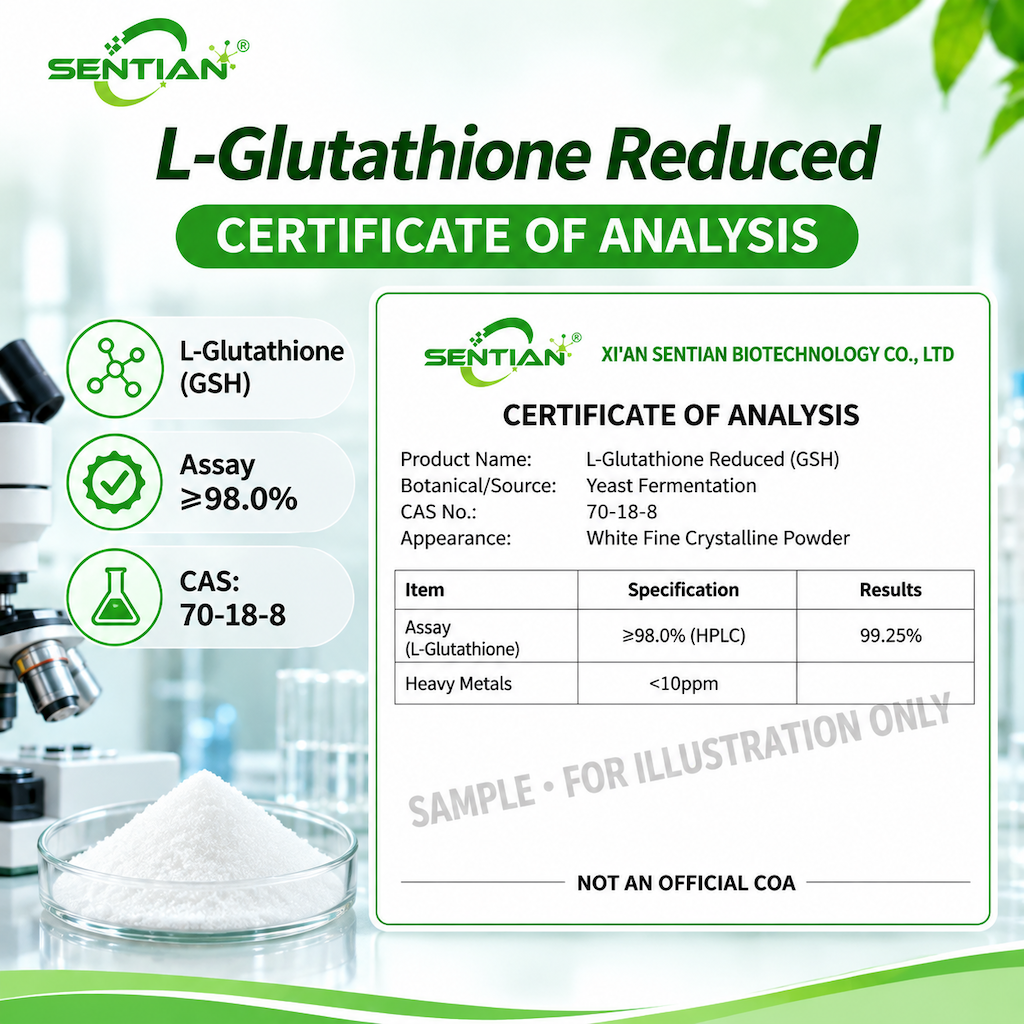
Standardization of GSH powder commonly focuses on assay content determined by high-performance liquid chromatography (HPLC). A specification of 98% or 99% should be interpreted in relation to the stated analytical method, reference standard, and reporting basis. Where the distinction between reduced and oxidized glutathione is important, the analytical method should be suitable for identifying and quantifying the reduced form rather than reporting only total glutathione.
Additional quality parameters include moisture, ash, heavy metals, and microbiological limits. The stated heavy metal panel covers lead, arsenic, cadmium, and mercury. Microbiological testing may include total aerobic count, yeast and mold, E. coli, and Salmonella. Actual acceptance limits should be defined in the applicable product specification and supported by the batch COA.
The ingredient is produced through microbial fermentation rather than chemical synthesis, according to the supplied product information. Available supporting documents include a Certificate of Analysis (COA), Material Safety Data Sheet (MSDS), and Technical Data Sheet (TDS). ISO 22000, HACCP, Halal, and Kosher documentation may also be available, subject to the relevant product and facility scope.
For storage, the powder should remain sealed in a cool, dry environment and be protected from light and high temperatures. Since the reduced form can undergo oxidation, packaging integrity and exposure to moisture and air should be considered throughout handling and storage. The stated shelf life is 24 months under appropriate storage conditions.
Product Categories : Raw Health Products > Nutritional Powder


Home > Products > Raw Health Products > Nutritional Powder > Reduced L-Glutathione GSH Powder 98% HPLC


Send Inquiry

Ms. Linda
Tel:
Fax:
Mobile Phone:+86 18602905487
Email:sales3@sentianbio.com
Address:Room 2002, Building B, Economic Development Building, Weiyang District, Xian, Shaanxi
Mobile Site

Privacy statement: Your privacy is very important to Us. Our company promises not to disclose your personal information to any external company with out your explicit permission.
Fill in more information so that we can get in touch with you faster
Privacy statement: Your privacy is very important to Us. Our company promises not to disclose your personal information to any external company with out your explicit permission.