


 Contact Now


Send Message
Privacy statement: Your privacy is very important to Us. Our company promises not to disclose your personal information to any external company with out your explicit permission.
Products
Model No.: ST-Astaxanthin
Origin: China
Product Name: Astaxanthin
Other Names: Astaxanthin Extract; Natural Astaxanthin
CAS No.: 472-61-7
Molecular Formula: C40H52O4
Molecular Weight: 596.84 g/mol
Grade: Food Grade
Application: Dietary Supplements, Functional Foods
Physical Form: Powder / Oleoresin
Packaging: 1kg/bag, 25kg/bag
Transportation: Ocean,Air,Express
Place of Origin: China
Supply Ability: 100000kg/month
Port: Shanghai,Qingdao,Tianjin
Payment Type: T/T
Incoterm: FOB,CIF,EXW,CPT,DDP


Astaxanthin is a naturally occurring xanthophyll carotenoid found in certain microalgae, yeast, and aquatic organisms. It is characterized by its red-orange color and belongs to the carotenoid family of pigments. As an ingredient, astaxanthin is used in dietary supplements, functional food formulations, and selected food applications where carotenoid content and color properties are relevant.
Commercial astaxanthin ingredients may be available in different forms, including powder, oleoresin, and formulated preparations. The actual composition depends on the raw material source, extraction process, concentration, and carrier system. Natural astaxanthin is commonly associated with the microalga Haematococcus pluvialis, although the source of a specific product should be confirmed through its product specification and supporting documentation.
For ingredient selection, buyers generally evaluate astaxanthin concentration, physical form, source, stability, and analytical testing methods. These factors influence how the ingredient can be incorporated into different formulations and how its quality is assessed.
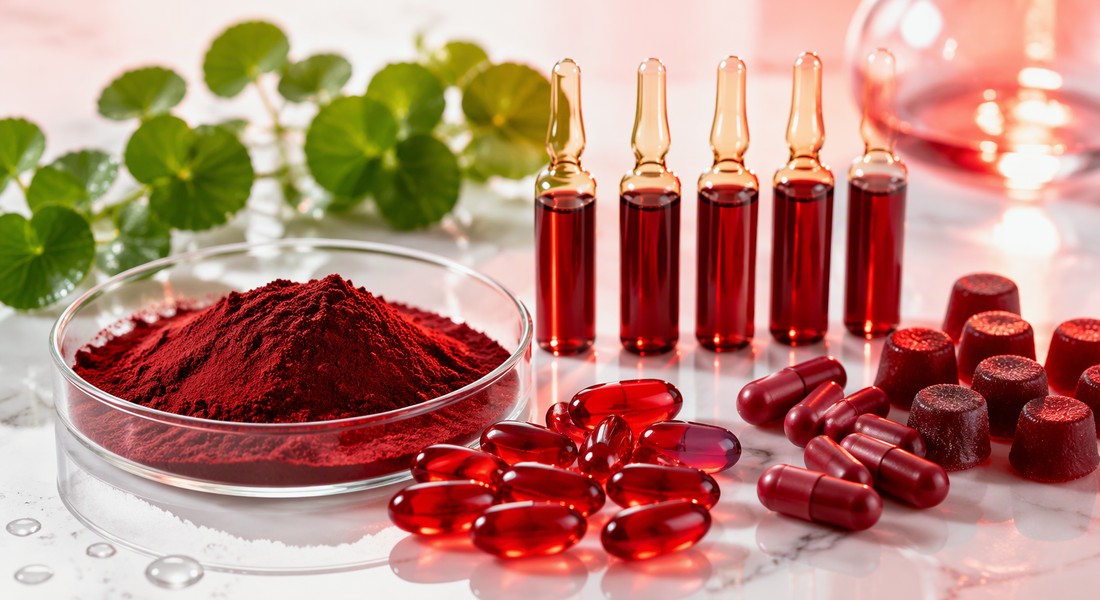
Astaxanthin is a fat-soluble carotenoid with a distinctive red-orange pigment profile. Its molecular structure contains conjugated double bonds and oxygen-containing functional groups. These structural features contribute to its color characteristics and influence its behavior in different formulation systems.
The ingredient's physical properties depend on its commercial form. Oil-based astaxanthin preparations are generally suitable for lipid-containing formulations, while powder products may be designed for blending with dry ingredients. Some powder preparations contain carriers or encapsulation materials to improve handling, dispersibility, or formulation compatibility. The exact carrier composition should be checked in the ingredient specification.
Astaxanthin is sensitive to environmental factors, particularly light, oxygen, and elevated temperatures. Exposure during processing or storage may affect carotenoid stability. Formulation development should therefore consider suitable packaging, controlled processing conditions, and storage recommendations. The stability of a finished product should be evaluated under its intended manufacturing and storage conditions.
Because astaxanthin is fat-soluble, its incorporation into a formulation requires consideration of the surrounding ingredient system. Oil-based delivery systems, emulsions, and suitable encapsulated powders may be considered depending on the product format. The selection of a suitable form should be based on the required concentration, processing conditions, and final product characteristics.
Astaxanthin is used as an ingredient in dietary supplement formulations. Common product formats include softgel capsules, hard capsules, tablets, and powder blends. Oil-based preparations may be considered for softgel applications, while powder preparations can be evaluated for dry blending and other solid dosage formats.
In functional food development, astaxanthin may be incorporated into products where carotenoid content and ingredient compatibility are relevant. Its use in beverages, powdered drinks, nutritional blends, and other food systems depends on the physical form, dispersion requirements, and applicable food regulations.
The ingredient may also be considered for selected food formulations as a color-related carotenoid ingredient, subject to the regulatory requirements of the target market. Permitted applications and labeling conditions vary by jurisdiction. Product developers should verify the applicable regulatory status before selecting astaxanthin for a specific food category.
During formulation development, several technical factors should be evaluated:
Concentration: The astaxanthin content determines the quantity of ingredient required in a formulation.
Physical form: Powder and oil-based preparations have different handling and processing requirements.
Dispersibility: The compatibility of the ingredient with the formulation matrix should be assessed.
Stability: Light, oxygen, temperature, and packaging conditions should be considered.
Quality documentation: Analytical results and batch-specific documentation should support ingredient evaluation.
Astaxanthin products should be evaluated according to their declared active content and overall composition. A standardized extract specifies the amount of astaxanthin in the ingredient, while a formulated powder or oil preparation may also contain carriers, stabilizers, or other processing aids. These additional components should be identified in the product documentation.
High-performance liquid chromatography (HPLC) is commonly used for the quantitative analysis of carotenoids, including astaxanthin. The analytical method, reference standard, sample preparation, and reporting basis should be reviewed when comparing products with different declared concentrations.
Quality evaluation may also include tests for heavy metals, microbiological parameters, moisture or loss on drying, and residual solvents, depending on the manufacturing process and intended application. The applicable limits should be established according to the product specification and relevant market requirements.
A batch-specific Certificate of Analysis (COA) can provide information about identity, assay, and other tested parameters. Buyers should review the COA together with the technical data sheet, ingredient declaration, and storage information to confirm that the material meets the requirements of the intended formulation.
Product Categories : Raw Health Products > Nutritional Powder


Home > Products > Raw Health Products > Nutritional Powder > Astaxanthin Extract: Technical Specifications, Composition and Formulation Applications


Send Inquiry

Ms. Linda
Tel:
Fax:
Mobile Phone:+86 18602905487
Email:sales3@sentianbio.com
Address:Room 2002, Building B, Economic Development Building, Weiyang District, Xian, Shaanxi
Related Products List
Mobile Site

Privacy statement: Your privacy is very important to Us. Our company promises not to disclose your personal information to any external company with out your explicit permission.
Fill in more information so that we can get in touch with you faster
Privacy statement: Your privacy is very important to Us. Our company promises not to disclose your personal information to any external company with out your explicit permission.