


 Contact Now


Send Message
Privacy statement: Your privacy is very important to Us. Our company promises not to disclose your personal information to any external company with out your explicit permission.
Products


Model No.: ST-Niacinamide
Product Name: Niacinamide
Synonyms: Nicotinamide, Vitamin B3
Chemical Category: Water-soluble vitamin
CAS Number: 98-92-0
Appearance: White crystalline powder
Chemical Formula: C6H6N2O
Molecular Weight: 122.12 g/mol
Main Cosmetic Grade: 99% Niacinamide
Food Grade: 98.5% or 99%
Assay Method: HPLC
Key Impurity: Nicotinic Acid
Solubility: Soluble in water
Quality Standards: USP, EP, FCC, according to grade and applicable specification
Documentation: Certificate of Analysis (COA)
Transportation: Ocean,Land,Air,Express
Supply Ability: 100000kgs
Port: Shanghai,Beijing,Qingdao
Payment Type: Paypal,T/T
Incoterm: FOB,Express Delivery,CIF,EXW,FCA,DDP



Niacinamide, also known as nicotinamide or vitamin B3, is a water-soluble form of vitamin B3 used in cosmetic, nutritional, food, pharmaceutical, and animal nutrition formulations. It is the amide form of vitamin B3 and differs chemically from nicotinic acid, although both compounds belong to the vitamin B3 family.
Niacinamide is typically supplied as a white crystalline powder with a defined assay range depending on its intended application and applicable quality standard. It is a synthetic vitamin ingredient rather than a botanical extract. Commercial grades include cosmetic grade, food grade, and pharmaceutical grade materials.
For cosmetic applications, 99% Niacinamide Powder is a commonly specified grade, particularly when formulation consistency and control of nicotinic acid impurities are important. In skincare formulations, niacinamide is incorporated into serums, creams, lotions, facial essences, and other topical products.
Food grade niacinamide is used in dietary supplements, fortified foods, beverages, and nutritional premixes. Pharmaceutical grade material may be manufactured and tested against applicable USP or EP requirements, with an assay specification of 98.5–101.5% where the relevant monograph applies.
The appropriate grade should be selected according to the intended application, regulatory requirements, formulation conditions, and quality documentation.

Niacinamide has several physicochemical and formulation characteristics that make it suitable for different product categories. Its water solubility allows it to be incorporated into aqueous systems, including cosmetic serums, lotions, creams, liquid supplements, and beverage formulations.
In cosmetic formulations, niacinamide is primarily used as a functional skincare ingredient. It is associated with skin barrier support, improved appearance of uneven skin tone, and the regulation of visible skin oiliness. It is also incorporated into formulations designed to improve the appearance of skin texture and maintain skin hydration.
The concentration of niacinamide in a finished cosmetic product depends on the product category, formulation objectives, stability requirements, and applicable cosmetic regulations. Compatibility with other ingredients, formulation pH, processing temperature, and storage conditions should be evaluated during product development.
In nutritional applications, niacinamide serves as a source of vitamin B3. It contributes to normal energy metabolism through its role as a precursor of nicotinamide adenine dinucleotide (NAD) and nicotinamide adenine dinucleotide phosphate (NADP). These coenzymes participate in numerous metabolic oxidation-reduction reactions.
For food and beverage applications, niacinamide can be used in vitamin fortification and nutritional premixes. Its selection should consider the target vitamin content, processing conditions, product matrix, and relevant food additive or nutrient regulations.
Pharmaceutical formulations may use niacinamide as an active pharmaceutical or nutritional ingredient, depending on the product category and applicable regulatory framework.

1. Skincare and Cosmetic Formulations
Cosmetic grade niacinamide is primarily used in topical skincare products. Typical applications include facial serums, moisturizing creams, lotions, toners, facial essences, masks, and other personal care formulations.
For these applications, buyers commonly evaluate assay purity, nicotinic acid content, appearance, solubility, and batch consistency. Nicotinic acid is an important impurity to monitor because its presence may contribute to skin flushing or irritation in susceptible users.
A 99% HPLC grade with controlled nicotinic acid content can therefore be considered when developing niacinamide-based cosmetic formulations. The actual impurity limit should be established in the purchasing specification.
2. Dietary Supplements
Niacinamide is used as a vitamin B3 ingredient in capsules, tablets, powders, and multivitamin formulations. It can be combined with other B-complex vitamins and nutritional ingredients according to the intended nutrient composition.
For supplement manufacturing, important quality parameters include assay, identity, heavy metals, microbial limits, and batch traceability.
3. Functional Foods and Beverages
Food grade niacinamide can be incorporated into fortified foods, nutritional drinks, powdered beverage mixes, and other products requiring vitamin B3 supplementation.
Formulators should assess its compatibility with the food matrix, processing temperature, storage environment, and applicable food regulations.
4. Pharmaceutical and Nutritional Formulations
Pharmaceutical grade niacinamide may be specified according to USP or EP requirements. Relevant quality attributes include assay, identification, impurity profile, and other tests required by the applicable pharmacopoeial monograph.
5. Animal Nutrition
Niacinamide can also be included in animal feed premixes and nutritional formulations as a source of vitamin B3. The appropriate grade and inclusion level depend on animal species, feed formulation, and applicable feed regulations.

Niacinamide is a chemically defined vitamin compound with the molecular formula C6H6N2O. Unlike botanical extracts, it does not have a plant-derived extraction ratio or a complex mixture of naturally occurring active constituents. Its quality evaluation is therefore based primarily on chemical identity, assay purity, impurity control, and physical and microbiological characteristics where applicable.
For cosmetic applications, 99% HPLC Niacinamide is a commonly requested specification. Particular attention should be given to nicotinic acid content because this impurity is relevant to the tolerability of topical formulations. A purchasing specification should clearly define the acceptable impurity limit rather than relying on the total assay value alone.
Food grade products may be specified at 98.5% or 99%, depending on the applicable standard and intended application. Pharmaceutical grade material may follow the USP or EP assay range of 98.5–101.5%, where the relevant pharmacopoeial requirements apply.
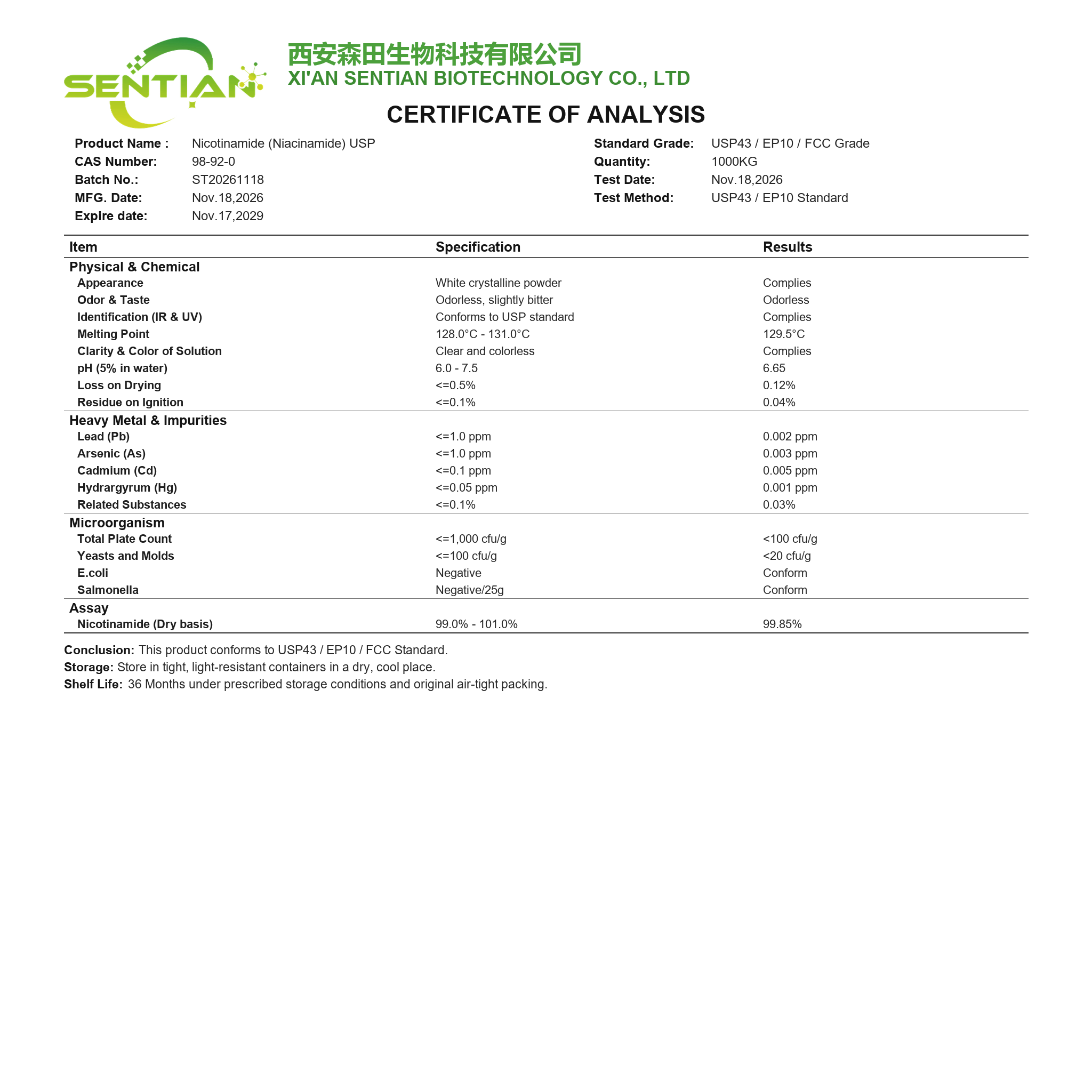
Routine quality control may include HPLC assay, nicotinic acid determination, heavy metal testing for lead, arsenic, cadmium, and mercury, loss on drying, residue on ignition, pH, melting point, and microbiological testing.
Microbiological evaluation may include total aerobic microbial count, yeast and mold, and specified microorganisms such as E. coli, according to the intended application and relevant specification.
A Certificate of Analysis (COA) should provide the applicable test results and acceptance criteria for each batch. Supporting documentation may be prepared according to USP, EP, or FCC requirements, subject to the actual product grade and testing scope.
Selecting the appropriate niacinamide specification requires consideration of the finished product category, assay requirements, impurity limits, applicable standards, and quality documentation. These factors help formulation developers establish consistent raw material requirements across cosmetic, nutritional, food, and pharmaceutical applications.
Product Categories : Raw Health Products > Nutritional Powder


Home > Products > Raw Health Products > Nutritional Powder > Niacinamide 99% Powder for Cosmetic Formulations


Send Inquiry

Ms. Linda
Tel:
Fax:
Mobile Phone:+86 18602905487
Email:sales3@sentianbio.com
Address:Room 2002, Building B, Economic Development Building, Weiyang District, Xian, Shaanxi
Related Products List
Mobile Site

Privacy statement: Your privacy is very important to Us. Our company promises not to disclose your personal information to any external company with out your explicit permission.
Fill in more information so that we can get in touch with you faster
Privacy statement: Your privacy is very important to Us. Our company promises not to disclose your personal information to any external company with out your explicit permission.