


 Contact Now


Send Message
Privacy statement: Your privacy is very important to Us. Our company promises not to disclose your personal information to any external company with out your explicit permission.
Products


Model No.: ST-Serrapeptase
Product Name: SerrapeptaseAlternative Name
Alternative Name: Serratiopeptidase
Product Type: Enzyme Powder
Enzyme Classification: Proteolytic Enzyme
Activity Specifications: 20,000 SPU/g
Additional Activity Grades: 40,000 SPU/g, 80,000 SPU/g
Appearance: Powder; actual appearance subject to product specification
Enzyme Activity TestingD: SPU Activity Assay
Heavy Metals Testing: Available as a quality control item
Microbiological Testing: Available as a quality control item
Quality Documentation: Certificate of Analysis (COA)
Primary Application: Dietary Supplements
Additional Applications: Functional Foods, Enzyme Formulations
Transportation: Ocean,Land,Air
Supply Ability: 100000kgs
Port: Shanghai,Qingdao,Tianjin
Payment Type: T/T,Paypal
Incoterm: FOB,CIF,EXW,FCA,DDP,Express Delivery



Serrapeptase, also known as serratiopeptidase, is a proteolytic enzyme originally isolated from the bacterium Serratia species. It belongs to the metalloprotease enzyme group and is characterized by its ability to hydrolyze specific peptide bonds in protein substrates. Serrapeptase is commonly supplied as an enzyme powder with activity expressed in Serrapeptase Units (SPU), providing a quantitative reference for evaluating enzyme potency.
Serrapeptase enzyme powder is available in different activity grades, including 20,000 SPU/g, 40,000 SPU/g, and 80,000 SPU/g. These specifications allow formulators to select an appropriate enzyme concentration according to formulation requirements, dosage considerations, and processing conditions.
In commercial ingredient applications, enzyme activity is an important parameter because the weight of an enzyme powder alone does not indicate its functional potency. Two products with identical powder weights may exhibit different enzymatic activities depending on their concentration and manufacturing specifications.
Serrapeptase is primarily considered for dietary supplement formulations, functional food development, and specialized enzyme formulations. Its use in these applications requires attention to enzyme activity, formulation compatibility, storage conditions, and quality control.
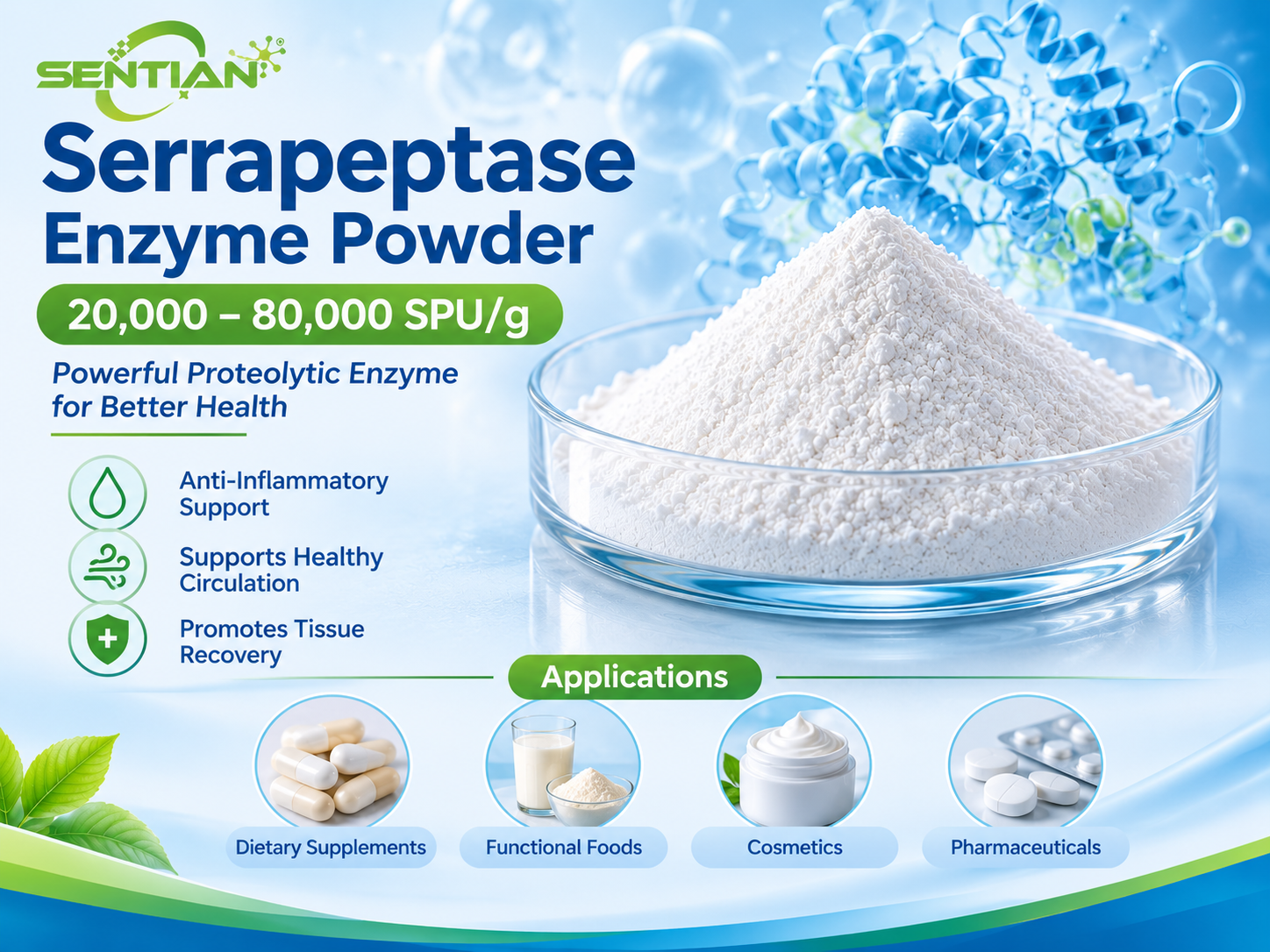

Serrapeptase is a proteolytic enzyme, meaning its primary biochemical function involves the breakdown of proteins into smaller peptides and related hydrolysis products. Its enzymatic activity is generally evaluated using a defined substrate and analytical procedure, with results expressed in SPU.
The three activity grades of 20,000 SPU/g, 40,000 SPU/g, and 80,000 SPU/g provide different concentration options for formulation development.
The selection of an activity grade depends on several technical considerations:
Enzyme activity concentration: Higher SPU/g specifications provide greater measured enzyme activity per gram of powder.
Formulation dosage: Activity concentration affects the quantity of raw material required to achieve a defined activity level in the finished formulation.
Processing compatibility: Temperature, moisture, pH, and processing duration can influence enzyme stability.
Ingredient interactions: Other formulation components may affect enzyme activity or product stability.
Storage conditions: Appropriate packaging and environmental controls are important for maintaining enzyme activity during storage.
For example, an 80,000 SPU/g specification provides four times the nominal activity per gram compared with a 20,000 SPU/g specification, assuming both values are measured using the same analytical method.
Enzyme activity should therefore be considered alongside powder weight when calculating formulation requirements. The analytical method used for activity determination should remain consistent when comparing different batches or activity grades.

1. Dietary Supplements
Dietary supplements are an important application category for serrapeptase enzyme powder. It can be incorporated into capsule, tablet, and other solid dosage formulations, depending on the intended product design.
During supplement development, formulators generally consider enzyme activity per serving, raw material concentration, compatibility with excipients, and stability throughout the product's shelf life.
Moisture control is particularly relevant for enzyme-based ingredients because exposure to unsuitable environmental conditions may reduce enzymatic activity. Protective packaging and appropriate storage conditions should be evaluated during product development.
2. Functional Foods
Serrapeptase may be evaluated for specialized functional food formulations where enzyme ingredients are permitted under applicable food regulations.
Its incorporation into food matrices requires consideration of processing temperature, moisture exposure, pH, and interactions with other ingredients. High-temperature processing may affect enzyme activity, making processing compatibility an important development parameter.
Regulatory requirements for enzyme ingredients vary between markets and product categories. Manufacturers should verify the applicable regulatory status before incorporating serrapeptase into commercial food products.
3. Enzyme Formulations
Serrapeptase can also be used as a component in specialized enzyme formulations. In this context, activity concentration and compatibility with other enzyme ingredients are important formulation considerations.
When combining serrapeptase with other proteolytic enzymes or functional ingredients, developers should evaluate potential interactions, activity retention, and storage stability.
The selected activity grade should correspond to the intended formulation design rather than relying solely on the total weight of the enzyme powder.
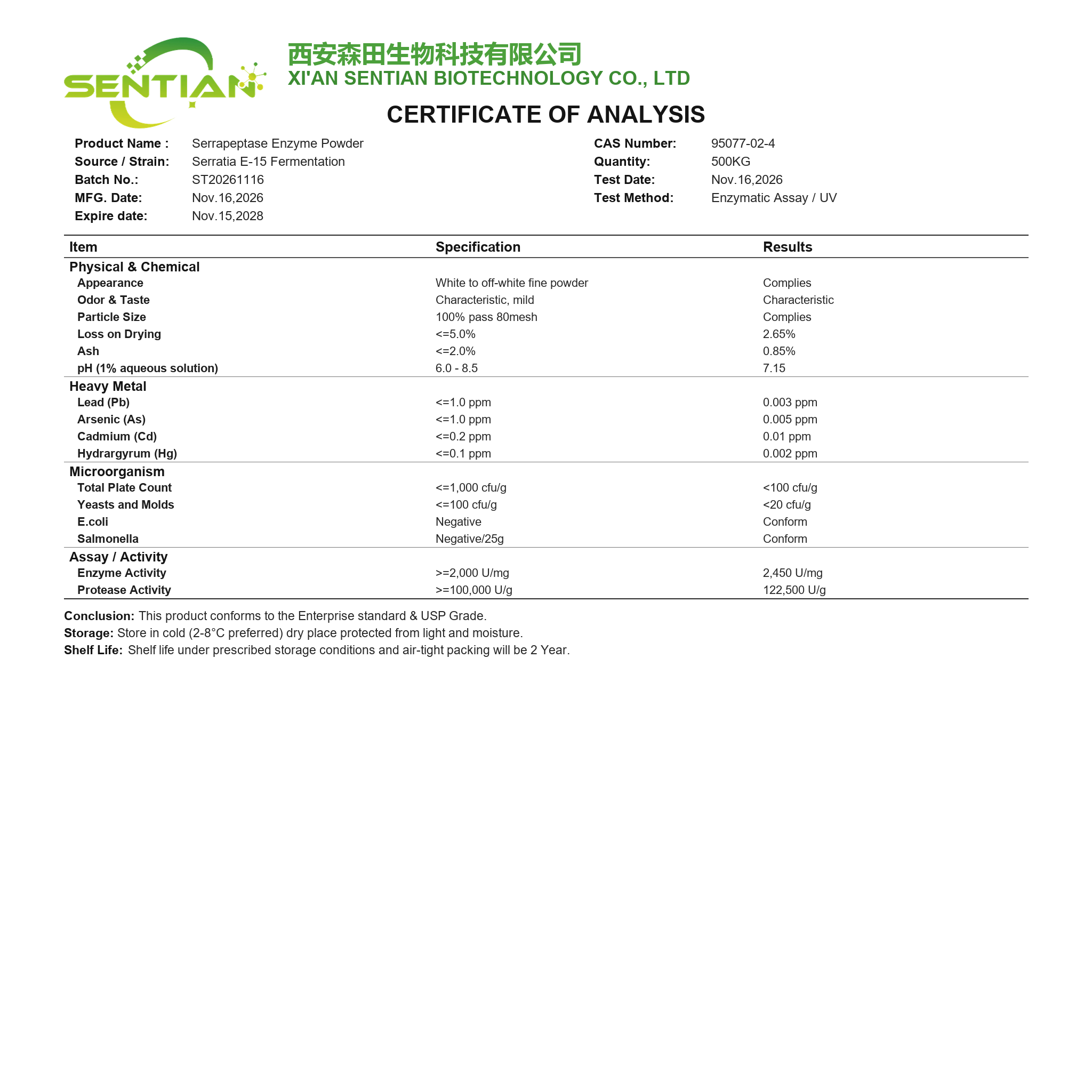

Serrapeptase enzyme powder is standardized primarily according to its enzymatic activity, expressed in SPU per gram. The available specifications of 20,000 SPU/g, 40,000 SPU/g, and 80,000 SPU/g represent different activity concentrations.
SPU activity testing is a central quality control parameter because it provides a quantitative measurement of enzyme potency. However, activity values should only be directly compared when the same or appropriately validated analytical methods are used.
A comprehensive quality evaluation may include the following items:
SPU Activity Assay: Determines the enzymatic activity of the powder and verifies compliance with the specified activity grade.
Heavy Metals Testing: Evaluates the levels of relevant heavy metal contaminants according to applicable quality standards.
Microbiological Testing: Assesses microbiological quality based on relevant testing requirements.
Certificate of Analysis: Documents the analytical results and batch-specific quality information.
The COA should correspond to the actual production batch and include the relevant analytical results. Additional parameters, such as moisture content, appearance, and other product-specific quality indicators, may also be included where applicable.
Standardization provides a basis for evaluating batch consistency and selecting appropriate raw material grades for different formulation requirements. By considering enzyme activity, analytical methods, and supporting quality documentation together, formulators can establish more consistent specifications for serrapeptase-based products.
Product Categories : Raw Health Products > Nutritional Powder


Home > Products > Raw Health Products > Nutritional Powder > Serrapeptase Enzyme Powder 20,000–80,000 SPU/g


Send Inquiry

Ms. Linda
Tel:
Fax:
Mobile Phone:+86 18602905487
Email:sales3@sentianbio.com
Address:Room 2002, Building B, Economic Development Building, Weiyang District, Xian, Shaanxi
Related Products List
Mobile Site

Privacy statement: Your privacy is very important to Us. Our company promises not to disclose your personal information to any external company with out your explicit permission.
Fill in more information so that we can get in touch with you faster
Privacy statement: Your privacy is very important to Us. Our company promises not to disclose your personal information to any external company with out your explicit permission.