


 Contact Now


Send Message
Privacy statement: Your privacy is very important to Us. Our company promises not to disclose your personal information to any external company with out your explicit permission.
Products
Model No.: ST-Sodium Hyaluronate
Origin: China
Product Name: Sodium Hyaluronate
Common Name: Hyaluronic Acid Sodium Salt
Grade: Food Grade
Product Form: Powder
Color: White
Specification: 99%
Shelf Life: 24 months
Sample: 10-20g
Packaging: 1kg/bag, 25kg/drum
Transportation: Ocean,Air,Express
Place of Origin: China
Supply Ability: 100000kg/month
Port: Shanghai,Tianjin,Qingdao
Payment Type: T/T
Incoterm: FOB,CIF,EXW,DDP,CPT


Sodium Hyaluronate is the sodium salt of hyaluronic acid, a naturally occurring polysaccharide composed of repeating disaccharide units. It is commonly obtained through microbial fermentation and subsequent purification processes. Food-grade Sodium Hyaluronate is used as a functional ingredient in selected food and beverage formulations, particularly products developed for nutritional supplementation and specialty food applications.
As a hydrophilic polysaccharide, Sodium Hyaluronate has the ability to interact with water and contribute to the physical characteristics of aqueous systems. Its functional properties are influenced by factors such as molecular weight, concentration, processing conditions, and the composition of the finished formulation.
Food-grade material is intended for applications where ingredient quality, purity, and compliance with applicable food regulations are important. The specific requirements may differ between markets and product categories. Therefore, its intended use should be evaluated according to the regulations of the target market.
Sodium Hyaluronate is available in different grades and specifications. For food applications, buyers generally need to confirm the product's grade, assay, molecular weight range, moisture content, microbiological quality, and relevant contaminant limits before selecting a suitable material.
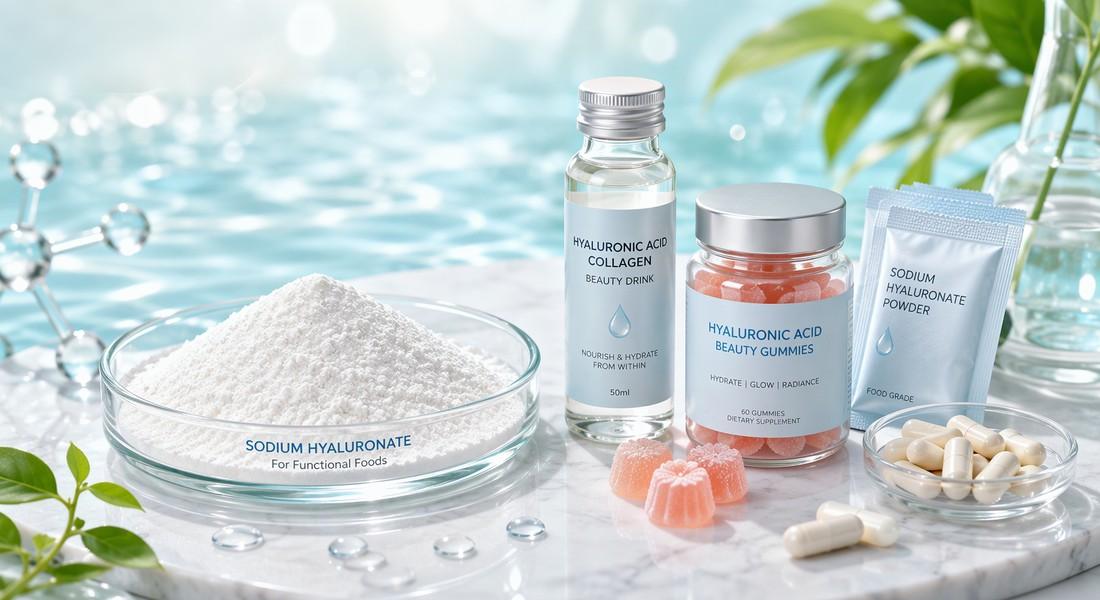
Sodium Hyaluronate is a water-interacting polysaccharide with functional characteristics that can be relevant to food formulation. Its behavior in a finished product depends on molecular weight, concentration, temperature, pH, ionic strength, and the presence of other ingredients.
Water interaction and hydration
Sodium Hyaluronate has hydrophilic properties and can interact with water in an aqueous formulation. This characteristic is relevant when developing products that require controlled hydration behavior. The rate of hydration and the resulting solution characteristics may vary with particle size, molecular weight, mixing conditions, and the concentration used.
Viscosity and texture
Depending on its molecular weight and application level, Sodium Hyaluronate may influence the viscosity and flow behavior of aqueous systems. Formulators should evaluate its effect in the complete formulation rather than relying on the ingredient's specification alone. Compatibility testing is particularly important when the product contains salts, proteins, acids, or other hydrocolloids.
Processing considerations
Sodium Hyaluronate is generally incorporated through controlled dispersion and hydration. Direct addition to water without sufficient mixing may lead to uneven dispersion or the formation of agglomerates. A gradual addition process, appropriate agitation, and adequate hydration time can help improve processing consistency.
Processing temperature, pH, and mechanical treatment should be evaluated during product development because these factors may affect the performance of the polysaccharide. The recommended processing conditions should be established through application testing using the actual material and formulation.
Ingredient compatibility
The performance of Sodium Hyaluronate may change in formulations containing electrolytes, acidic ingredients, proteins, or other thickening agents. Formulation trials can help determine suitable addition levels, mixing sequences, and storage conditions.
Food-grade Sodium Hyaluronate may be considered for several types of food and nutritional formulations, subject to applicable regulations and permitted use levels.
Dietary supplements
Sodium Hyaluronate can be incorporated into dietary supplement formulations in powder, capsule, tablet, or other suitable formats. Its selection depends on the intended dosage form, manufacturing process, ingredient compatibility, and regulatory requirements in the destination market.
Functional foods
In functional food development, Sodium Hyaluronate may be evaluated as a specialty ingredient for products requiring a defined polysaccharide component. Its suitability depends on the product category, formulation characteristics, processing conditions, and applicable food ingredient regulations.
Powder blends
Sodium Hyaluronate powder may be included in selected dry blends and powdered nutritional formulations. Particle size, bulk density, moisture content, and blending uniformity should be considered when combining it with other powdered ingredients.
Beverage formulations
For beverage applications, formulators should assess dispersion, hydration, clarity, viscosity, and storage stability. The performance of Sodium Hyaluronate can vary according to beverage acidity, mineral content, processing temperature, and other formulation components. Pilot testing is recommended before commercial production.
The suitability of Sodium Hyaluronate for any specific food application should be confirmed against the relevant food regulations. Food-grade designation alone does not establish authorization for every food category or market.
Sodium Hyaluronate is a polysaccharide consisting of repeating units derived from glucuronic acid and N-acetylglucosamine. In its sodium salt form, it is commonly identified by the chemical name Sodium Hyaluronate and is associated with hyaluronic acid.
Commercial Sodium Hyaluronate may differ in molecular weight distribution, purity, moisture content, and physical properties. These parameters can influence its hydration behavior, viscosity contribution, and suitability for different formulation systems.
For food-grade applications, standardization should be based on a defined product specification and batch-specific analytical documentation. Important quality parameters may include identity, assay, molecular weight, loss on drying, pH, ash content, heavy metals, and microbiological limits.
Quality control may involve analytical testing for identity and purity, together with contaminant and microbiological assessments. The exact methods and acceptance criteria should be stated in the product specification or Certificate of Analysis (COA). Buyers should confirm whether the analytical methods are appropriate for the intended application and destination market.
A complete technical review should also consider the manufacturing source, fermentation and purification controls, traceability, packaging conditions, and storage recommendations. These details help determine whether a specific Sodium Hyaluronate batch is suitable for the intended food formulation.
Product Categories : Raw Health Products > Nutritional Powder


Home > Products > Raw Health Products > Nutritional Powder > Sodium Hyaluronate Food Grade: Technical Specifications and Food Formulation Applications


Send Inquiry

Ms. Linda
Tel:
Fax:
Mobile Phone:+86 18602905487
Email:sales3@sentianbio.com
Address:Room 2002, Building B, Economic Development Building, Weiyang District, Xian, Shaanxi
Related Products List
Mobile Site

Privacy statement: Your privacy is very important to Us. Our company promises not to disclose your personal information to any external company with out your explicit permission.
Fill in more information so that we can get in touch with you faster
Privacy statement: Your privacy is very important to Us. Our company promises not to disclose your personal information to any external company with out your explicit permission.