


Send Message
Privacy statement: Your privacy is very important to Us. Our company promises not to disclose your personal information to any external company with out your explicit permission.
News
Home > Industry News > NAD+ (Nicotinamide Adenine Dinucleotide): Growing Interest in Cellular Energy, Healthy Aging, and Dietary Supplement Formulations
2026-11-17
Nicotinamide Adenine Dinucleotide (NAD+) is an essential coenzyme found in virtually all living cells. It plays a central role in cellular metabolism, energy production, and numerous biological processes. As scientific interest in cellular health, mitochondrial function, and healthy aging continues to grow, NAD+ has become an increasingly discussed ingredient in the global nutraceutical and dietary supplement industries.
The growing interest in NAD+ is closely connected to research into cellular energy metabolism and age-related changes in NAD+ levels. Researchers are investigating how NAD+ metabolism interacts with mitochondrial activity, DNA repair pathways, and cellular stress responses.
For dietary supplement brands, contract manufacturers, and ingredient distributors, NAD+ represents an interesting ingredient category within the expanding healthy aging and cellular wellness market. It also creates opportunities for innovative formulations involving NAD+, NMN (Nicotinamide Mononucleotide), and NR (Nicotinamide Riboside).
NAD+ stands for Nicotinamide Adenine Dinucleotide. It is a naturally occurring coenzyme involved in essential biochemical reactions throughout the body.
NAD+ exists in two primary forms:
NAD+ (oxidized form): Accepts electrons during metabolic reactions.
NADH (reduced form): Carries electrons and participates in energy-generating processes.
The NAD+/NADH redox cycle is fundamental to cellular metabolism. It supports processes such as glycolysis, the citric acid cycle, and mitochondrial oxidative phosphorylation.
Beyond energy metabolism, NAD+ also serves as a substrate for several important enzyme families, including sirtuins and poly (ADP-ribose) polymerases (PARPs). These enzymes are involved in cellular signaling, gene regulation, and DNA repair mechanisms.
Because of these diverse biological roles, NAD+ has attracted considerable attention in nutritional science, longevity research, and the development of advanced dietary supplements.
One of the most important functions of NAD+ is its participation in cellular energy production.
During metabolic reactions, NAD+ accepts electrons and becomes NADH. NADH subsequently transfers electrons to the mitochondrial electron transport chain, helping support ATP production.
ATP (adenosine triphosphate) is the primary energy currency of cells.
This relationship makes NAD+ an important subject in research related to:
Cellular energy metabolism
Mitochondrial function
Oxidative phosphorylation
Metabolic pathways
Cellular redox balance
Energy homeostasis
For supplement manufacturers, cellular energy metabolism is an important positioning area when developing products for the healthy aging and active lifestyle markets.
NAD+ metabolism has become an important research topic in the field of aging biology.
Some studies have reported changes in NAD+ availability with aging, although the extent of these changes varies across tissues, populations, and measurement methods.
Scientists are particularly interested in the relationship between NAD+ and several cellular processes:
Mitochondrial Function
NAD+ participates in metabolic pathways that supply reducing equivalents to mitochondria. Researchers are investigating its relationship with mitochondrial energy metabolism and cellular function.
Sirtuin Activity
Sirtuins are a family of NAD+-dependent enzymes involved in cellular regulation, metabolic signaling, and stress responses. NAD+ availability is one factor influencing their activity.
DNA Repair
PARP enzymes use NAD+ as a substrate during DNA damage response and repair processes. This connection has made NAD+ an important subject in cellular maintenance research.
Cellular Stress Responses
NAD+ is involved in multiple signaling pathways associated with oxidative stress, inflammation, and cellular adaptation.
Although these mechanisms are scientifically interesting, their potential translation into measurable human health benefits requires further clinical investigation. NAD+ supplementation should not be marketed as a proven anti-aging treatment.
NAD+, NMN, and NR are closely related compounds frequently discussed in the cellular health and longevity supplement markets. However, they are not interchangeable ingredients.
| Ingredient | Full Name | Main Characteristics |
|---|---|---|
| NAD+ | Nicotinamide Adenine Dinucleotide | A central cellular coenzyme involved in energy metabolism and redox reactions |
| NMN | Nicotinamide Mononucleotide | An NAD+ biosynthetic precursor |
| NR | Nicotinamide Riboside | A vitamin B3-related compound and NAD+ precursor |
NAD+ is the coenzyme itself, while NMN and NR are compounds involved in NAD+ biosynthesis.
These ingredients have attracted attention from supplement brands developing cellular health, healthy aging, and metabolic wellness formulations.
When selecting an ingredient, manufacturers should consider its chemical identity, purity, stability, formulation compatibility, and intended product category.
Scientific research into NAD+ metabolism continues to expand.
A 2025 review published in Nature Metabolism examined clinical evidence surrounding NAD+ precursor supplementation in human aging. The authors highlighted the biological importance of NAD+ while emphasizing that clinical evidence for broader health benefits remains limited.
In 2026, a systematic review published in Ageing Research Reviews evaluated 113 preclinical and clinical studies on NAD+-related supplementation. The review found that human studies of NAD+ precursors such as NMN and NR frequently demonstrated changes in NAD-related biomarkers. However, evidence for improvements in functional, metabolic, and other health-related outcomes remained inconsistent.
These findings highlight two important industry trends:
Growing scientific interest in NAD+ metabolism and cellular health.
Increasing demand for reliable ingredient quality, transparent specifications, and scientifically responsible product positioning.
For supplement manufacturers, keeping up with emerging research is essential when developing new NAD+-related products and communicating with consumers.
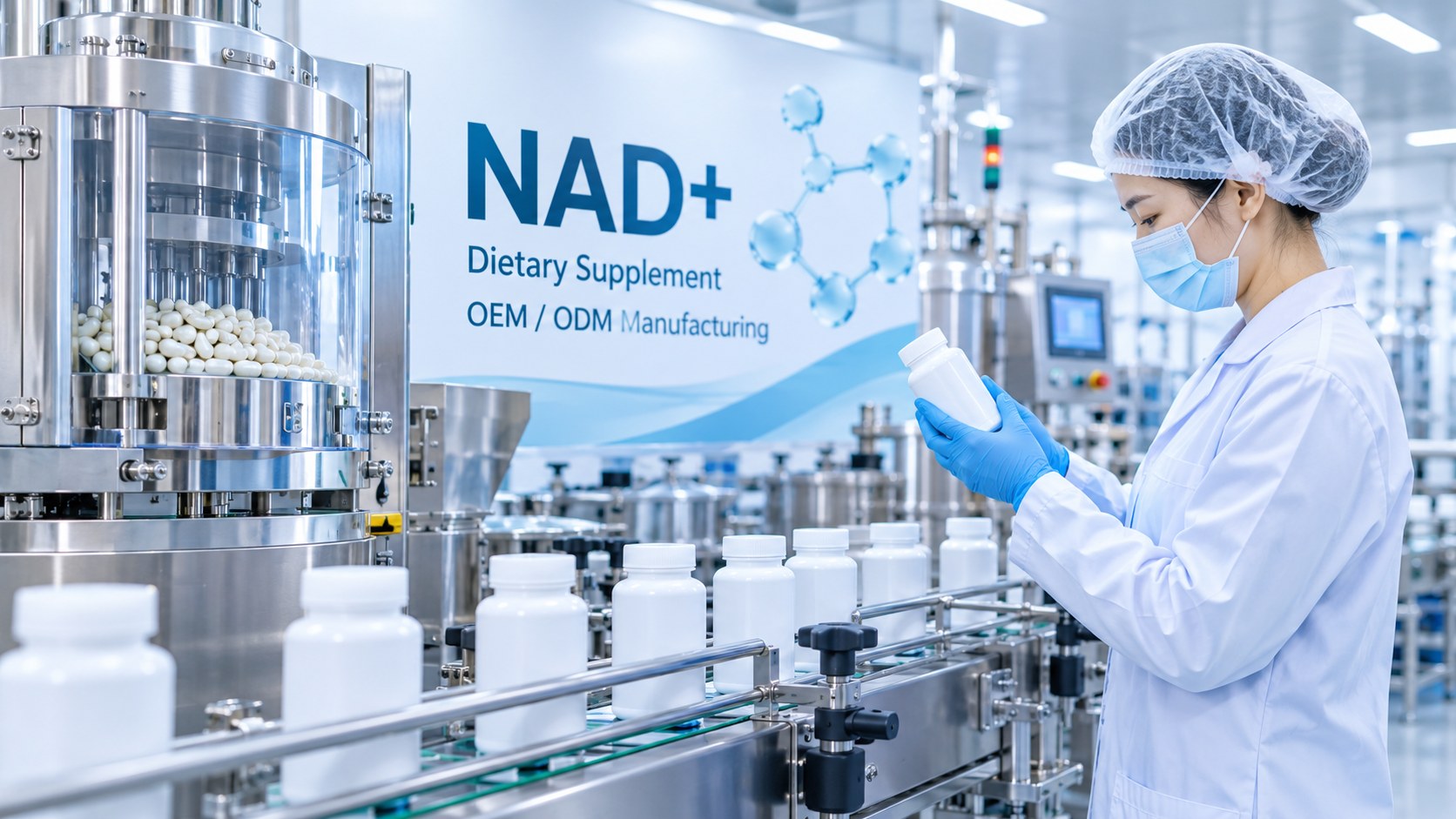
NAD+ is attracting attention from manufacturers developing products for the growing cellular wellness and healthy aging markets.
Depending on ingredient specifications, formulation compatibility, and applicable market regulations, NAD+-related ingredients may be considered for several product categories.
NAD+ Capsules
Capsules are a practical format for powdered nutritional ingredients. They are widely used in dietary supplement manufacturing and allow brands to develop convenient daily supplement products.
NAD+ Tablets
Tablets offer another formulation option for manufacturers looking to develop standardized solid-dose supplements.
NAD+ Powder Supplements
Powder formats provide flexibility for customized formulations and ingredient combinations. Their suitability depends on the ingredient's solubility, stability, processing conditions, and finished-product requirements.
NAD+ Complex Formulations
Some supplement brands explore combinations involving NAD+, NMN, NR, Coenzyme Q10, resveratrol, and other ingredients associated with cellular metabolism research.
However, each ingredient combination should be evaluated for compatibility, stability, regulatory compliance, and substantiation of marketing claims.
For dietary supplement manufacturers and ingredient distributors, choosing a reliable NAD+ raw material supplier is an important part of product development.
The following factors deserve particular attention:
1. Purity and Assay
Check the NAD+ assay and purity specifications, together with the analytical method used. HPLC is commonly used for ingredient identification and quantitative analysis.
2. Certificate of Analysis (COA)
A batch-specific COA should provide relevant information, such as appearance, identification, assay, moisture, and applicable microbiological and contaminant testing.
3. Stability and Storage
NAD+ stability can be affected by environmental conditions, including temperature, moisture, and formulation characteristics. Manufacturers should follow validated storage recommendations and assess stability throughout processing and shelf life.
4. Manufacturing and Quality Control
Evaluate the supplier's quality management system, manufacturing controls, traceability, and supporting documentation.
5. Regulatory Documentation
Requirements vary by destination market and intended application. Buyers should review the relevant food-grade or supplement-grade specifications, regulatory status, and supporting documents before commercial production.
Working with an experienced NAD+ ingredient supplier can help supplement brands improve sourcing efficiency and streamline formulation development.
The growing focus on healthy aging, cellular wellness, mitochondrial research, and metabolic health is creating new opportunities for NAD+-related ingredients.
As scientific understanding develops, manufacturers are exploring more targeted formulations and differentiated supplement concepts.
Potential areas of continued product development include:
Cellular health and wellness supplements
Healthy aging formulations
NAD+ and NADH-related nutritional products
NMN and NR combination concepts
Advanced capsule and tablet formulations
Customized nutraceutical blends
For ingredient suppliers, consistent product quality, reliable documentation, and flexible supply capabilities will remain important competitive factors.
Nicotinamide Adenine Dinucleotide (NAD+) is an essential coenzyme with important roles in cellular energy metabolism, mitochondrial processes, and cellular signaling. Its connection with healthy aging research has made it an increasingly relevant ingredient in the nutraceutical industry.
As interest in NAD+ supplements continues to develop, supplement brands and manufacturers need dependable raw material suppliers who can provide consistent quality, technical documentation, and professional sourcing support.
At Xi'an Sentian Biotechnology Co., Ltd., we specialize in supplying nutritional ingredients, natural extracts, and customized OEM/ODM supplement manufacturing solutions.
Whether you are sourcing NAD+ powder for your next dietary supplement project or exploring customized capsules, tablets, and other finished-product solutions, our team is ready to support your business.
Contact Sentian Bio to discuss your NAD+ ingredient requirements and request product specifications, a COA, or a quotation.
Website: www.sentianbio.com
Email: sales11@sentianbio.com
Share to:


Send Inquiry

Ms. Linda
Tel:
Fax:
Mobile Phone:+86 18602905487
Email:sales3@sentianbio.com
Address:Room 2002, Building B, Economic Development Building, Weiyang District, Xian, Shaanxi
Related Products List
Mobile Site

Privacy statement: Your privacy is very important to Us. Our company promises not to disclose your personal information to any external company with out your explicit permission.
Fill in more information so that we can get in touch with you faster
Privacy statement: Your privacy is very important to Us. Our company promises not to disclose your personal information to any external company with out your explicit permission.