


 Contact Now


Send Message
Privacy statement: Your privacy is very important to Us. Our company promises not to disclose your personal information to any external company with out your explicit permission.
Products
Model No.: ST-Lactoferrin
Product Name: Bovine Lactoferrin Powder
Ingredient Type: Dairy-derived iron-binding glycoprotein
Target Lactoferrin Content: 95%
Source Material: Bovine milk or whey
Production Process: Ion-exchange separation, ultrafiltration, concentration, and spray drying, depending on the process
Lactoferrin Assay: HPLC using heparin-affinity chromatography, referenced to AOAC 2021.10 as specified
Moisture: Tested according to the applicable product specification
Heavy Metals: Arsenic (As), lead (Pb), cadmium (Cd), and mercury (Hg)
Microbiological Testing: Total plate count, coliforms, Salmonella, Listeria, and yeast and mold
Documentation: Certificate of analysis (COA) available
Intended Formulation Categories: Infant formula, formulated milk powder, dietary supplements, nutritional powders, foods for special medical purposes, powdered beverages, and dairy products
Storage And Handling: Follow the product-specific technical data sheet and packaging instructions
Regulatory Suitability: Subject to the intended use, applicable jurisdiction, and relevant food regulations
Packaging: 25kgs packaging Fiber drum outside and plastic bag inside 1-25kgs packaging aluminium bag outside and double plastic bag inside.
Transportation: Land,Ocean,Air,Express
Supply Ability: 100000
Port: Shanghai,Qingdao,Beijing
Payment Type: T/T,Paypal
Incoterm: FOB,DDP,CIF,FCA,Express Delivery


Product description
Bovine lactoferrin powder is commonly produced through a series of separation and purification steps. Depending on the manufacturing process, these may include ion-exchange separation, ultrafiltration, concentration, and spray drying. The objective is to obtain a powder with a defined lactoferrin content while maintaining appropriate physicochemical and microbiological characteristics.
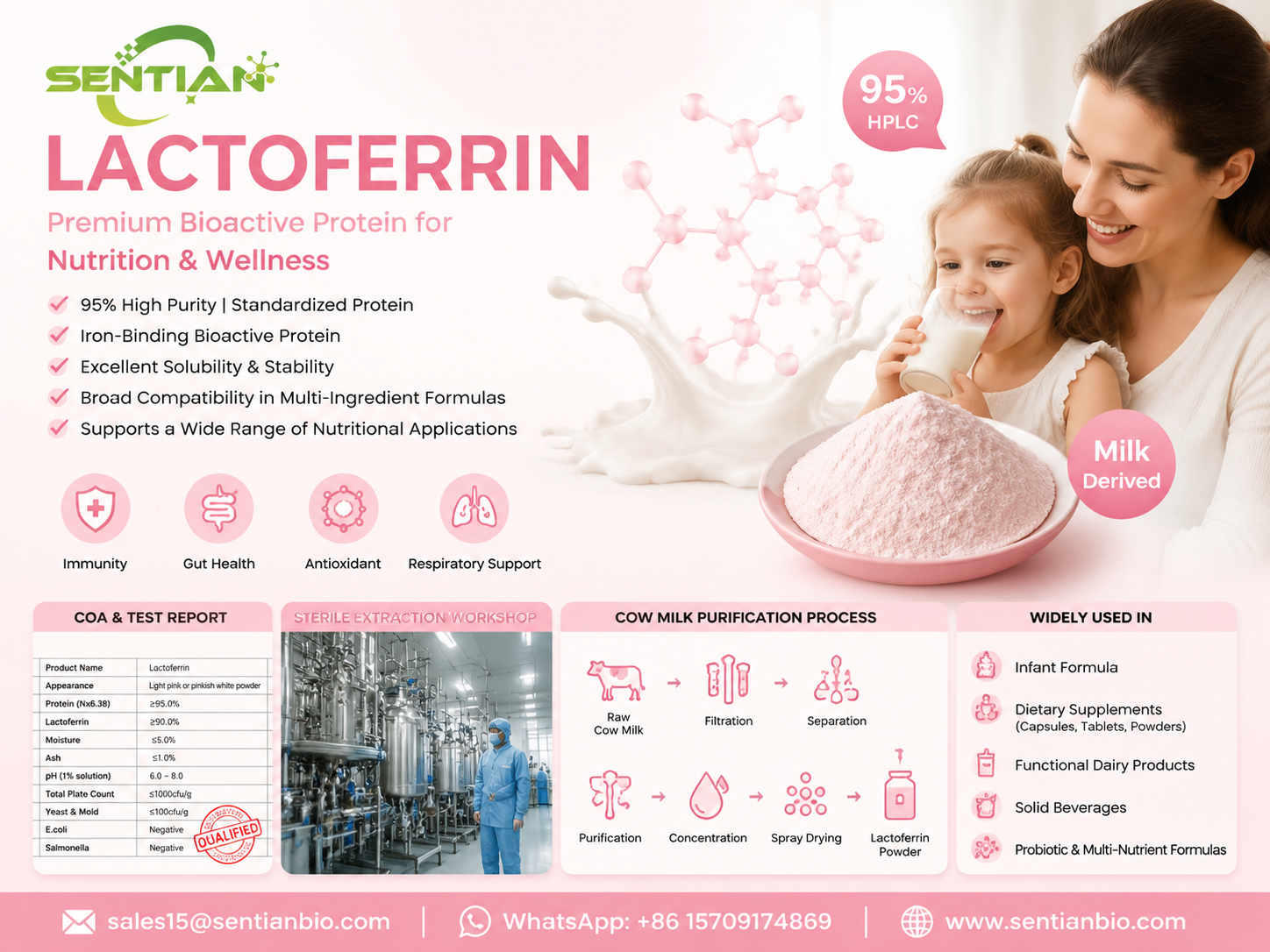

A 95% bovine lactoferrin specification is intended for formulations requiring a high proportion of the target protein. The actual product specification should define how lactoferrin content is calculated, the analytical method used, and the applicable acceptance criteria. High-purity lactoferrin powder may be considered for infant formula, nutritional powders, dietary supplements, and other food applications, subject to relevant regulatory requirements and formulation suitability.
For ingredient evaluation, buyers and formulation teams generally review lactoferrin content, protein characteristics, moisture, ash, pH, heavy metals, and microbiological results. A certificate of analysis (COA) provides batch-specific analytical information to support incoming quality control, supplier qualification, and formulation development.
 Lactoferrin is a globular glycoprotein with iron-binding properties. Its functional behavior is influenced by iron saturation, protein structure, pH, temperature, and the surrounding formulation matrix. These variables are important when incorporating bovine lactoferrin into products that undergo heating, drying, reconstitution, or extended storage.
In powdered formulations, moisture control is an important consideration. Excessive moisture exposure can affect powder flow, storage stability, and the physical properties of protein ingredients. Packaging selection, humidity control, and suitable storage conditions should therefore be assessed during product development.
Lactoferrin is also sensitive to processing conditions. Heat exposure, extreme pH, and interactions with other ingredients may influence protein structure and functional characteristics. When the ingredient is intended for a formulation involving thermal treatment, pilot-scale testing can help determine whether the selected processing conditions are compatible with the required product specifications.
The solubility and dispersion behavior of bovine lactoferrin should be evaluated in the intended application. Performance may vary with pH, ionic strength, protein concentration, and the presence of minerals, carbohydrates, fats, or other proteins. Formulators should assess dissolution time, dispersion uniformity, sedimentation, and any changes in appearance during preparation and storage.
A high lactoferrin content can reduce the quantity of ingredient needed to achieve a specified lactoferrin input, but it does not eliminate the need for compatibility testing. The overall performance of a finished product depends on the full formulation, processing conditions, packaging, and storage environment.

Infant formula and formulated milk powder
Bovine lactoferrin may be considered as an ingredient in infant formula and formulated milk powder where its use is permitted and supported by the applicable product standards. Formulation teams need to evaluate ingredient identity, purity, microbiological quality, processing stability, and the permitted inclusion level. Requirements differ across jurisdictions, so regulatory review should precede commercial use.
Dietary supplements
Lactoferrin powder can be incorporated into selected capsule, tablet, sachet, or powdered supplement formats, depending on the formulation design. Key considerations include the intended serving size, compatibility with excipients, moisture sensitivity, powder flow, and content uniformity. Product claims should remain consistent with applicable food and supplement regulations.
Functional nutritional powders and powdered beverages
In nutritional powders and powdered beverages, lactoferrin may be combined with proteins, carbohydrates, minerals, vitamins, or other functional ingredients. Compatibility testing is important because mineral content, pH, and reconstitution conditions can affect dispersion and protein stability. Sensory properties and processing losses should also be evaluated in the finished formulation.
Foods for special medical purposes
In foods for special medical purposes, ingredient selection requires careful review of the target population, nutritional design, applicable regulatory framework, and product-specific clinical or technical requirements. Lactoferrin inclusion should be determined by qualified formulation and regulatory teams rather than inferred from its general functional properties.
Dairy products
Lactoferrin may be evaluated for use in selected dairy-based products. Its behavior depends on the product's protein composition, acidity, heat treatment, and storage conditions. Testing should cover dispersion, stability, and compatibility with the dairy matrix throughout the intended shelf life.
 Bovine lactoferrin is a glycoprotein naturally present in bovine milk. Commercial powder is obtained by separating lactoferrin from a dairy starting material and processing it into a concentrated ingredient. The final composition depends on the raw material, separation efficiency, purification steps, drying conditions, and quality-control specifications.
For a product labeled as 95% bovine lactoferrin, the analytical definition of the percentage is essential. Buyers should verify whether the stated value refers to lactoferrin measured by a specified assay and whether the result is expressed on an as-is or dry basis. These details influence the interpretation of test results and comparisons between ingredient grades.
HPLC with heparin-affinity chromatography, referenced to AOAC 2021.10 as specified for the product, can be used as the designated lactoferrin assay when the method is applicable to the material and its validated scope. The exact method reference, sample preparation, calculation basis, and acceptance limits should be documented in the relevant specification and testing records.
A complete quality-control program may include lactoferrin content, moisture, ash, total protein, pH, heavy metals, and microbiological testing. Microbiological testing may cover total plate count, coliforms, Salmonella, Listeria, and yeast and mold. Applicable limits and methods should be defined according to product requirements and relevant regulations.
Batch-specific documentation supports traceability and quality review. A COA should identify the tested batch, analytical parameters, results, methods, and applicable limits. Additional documentation may be requested according to the intended application and the buyer's quality-management procedures.
Standardization is therefore not limited to a nominal percentage. It includes a clear assay definition, documented analytical methods, controlled manufacturing processes, and suitable batch-release criteria. These elements help formulation teams evaluate bovine lactoferrin powder consistently across development, procurement, and production.
Product Categories : Raw Health Products > Nutritional Powder


Home > Products > Raw Health Products > Nutritional Powder > Bovine Lactoferrin Powder 95% for Nutritional and Infant Formula Applications


Send Inquiry

Ms. Linda
Tel:
Fax:
Mobile Phone:+86 18602905487
Email:sales3@sentianbio.com
Address:Room 2002, Building B, Economic Development Building, Weiyang District, Xian, Shaanxi
Mobile Site

Privacy statement: Your privacy is very important to Us. Our company promises not to disclose your personal information to any external company with out your explicit permission.
Fill in more information so that we can get in touch with you faster
Privacy statement: Your privacy is very important to Us. Our company promises not to disclose your personal information to any external company with out your explicit permission.