


 Contact Now


Send Message
Privacy statement: Your privacy is very important to Us. Our company promises not to disclose your personal information to any external company with out your explicit permission.
Products
Model No.: ST-Nattokinase
Product Name: Nattokinase
Source: Bacillus subtilis var. natto fermentation
Grade: Food Grade / Dietary Supplement Ingredient Grade
Appearance: White to off-white fine powder
Enzyme Activity: 2,000 / 5,000 / 10,000 / 20,000 FU/g
Recommended Specification: 10,000 FU/g
CAS Number: 133876-92-3
EC Number: EC 3.4.21.62
Particle Size: 80 mesh / 100 mesh; customized 120 mesh available
Ash: ≤7.0%
Activity Testing: Fibrin plate assay; chromogenic substrate assay
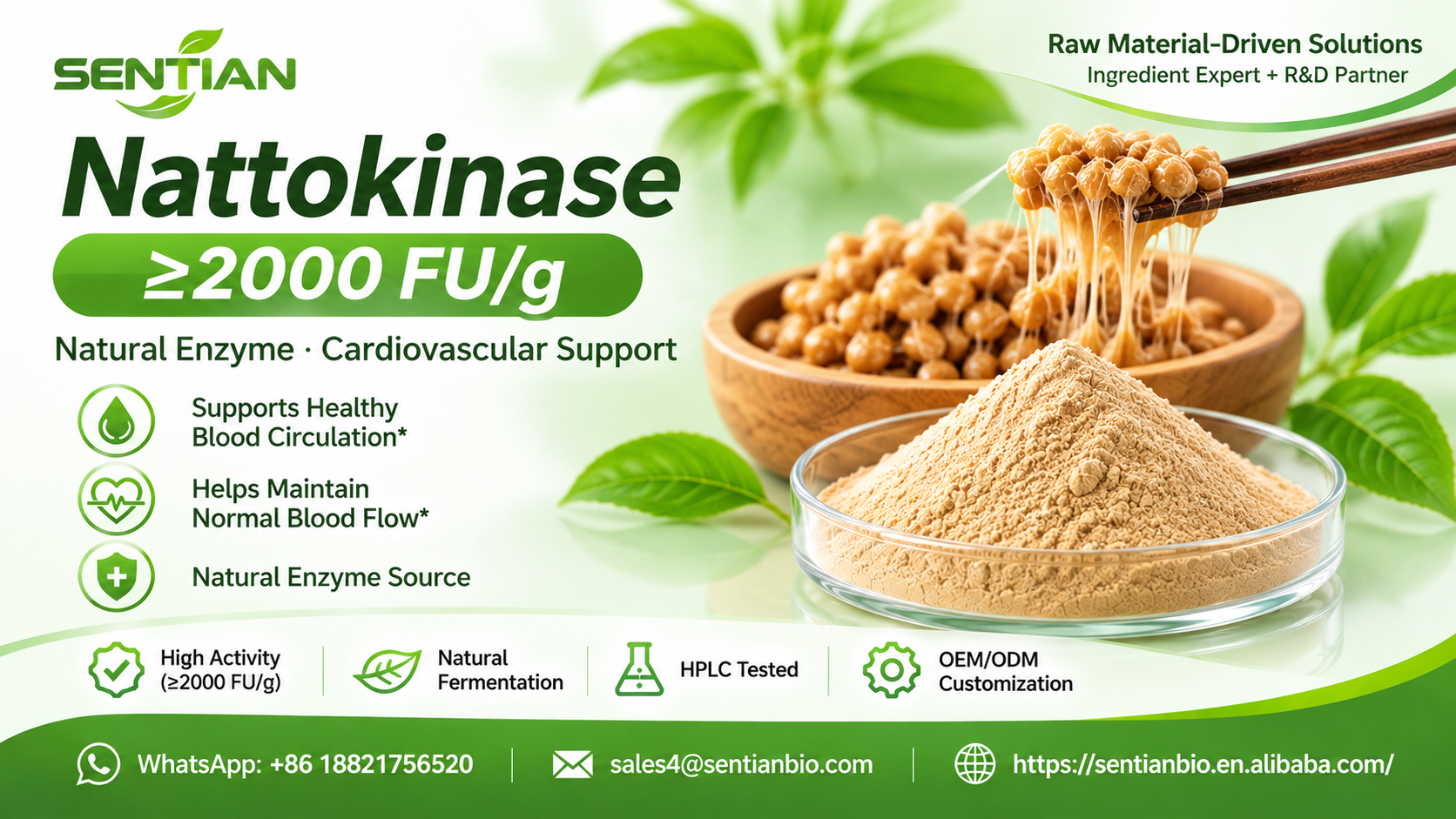
Nattokinase is a proteolytic enzyme produced through fermentation by Bacillus subtilis var. natto, the microorganism associated with traditional fermented soybean food natto. It belongs to the alkaline serine protease family and is characterized by its ability to hydrolyze protein substrates, including fibrin, under laboratory conditions. Nattokinase is commonly processed into a fine powder for use as a dietary supplement ingredient and functional nutrition raw material.
Commercial nattokinase powder is generally obtained through liquid or solid-state fermentation of soybean-based substrates, followed by concentration, purification, and spray drying. Processing conditions and purification methods can influence enzyme activity, protein composition, moisture content, and powder characteristics. Some ingredient preparations are also available with reduced or removed vitamin K2 content, depending on the production process and product specification.
Nattokinase is standardized by enzymatic activity rather than simply by powder weight. Common commercial specifications include 2,000 FU/g, 5,000 FU/g, 10,000 FU/g, and 20,000 FU/g. FU, or fibrinolytic unit, is an activity measurement used to characterize the enzyme's ability to break down fibrin under specified assay conditions. Activity values should be interpreted according to the method used for measurement and are not equivalent to pharmaceutical dosage or clinical efficacy.
| Parameter | Specification |
|---|---|
| Product Name | Nattokinase |
| Source | Bacillus subtilis var. natto fermentation |
| Grade | Food Grade / Dietary Supplement Ingredient Grade |
| Appearance | White to off-white fine powder |
| Enzyme Activity | 2,000 / 5,000 / 10,000 / 20,000 FU/g |
| Recommended Specification | 10,000 FU/g |
| Vitamin K2 | Optional K2-reduced or K2-removed version |
| CAS Number | 133876-92-3 |
| EC Number | EC 3.4.21.62 |
| Molecular Weight | Approximately 27,700 Da |
| Molecular Formula | Not applicable as a fixed small-molecule formula; protein enzyme |
| Protein Structure | Mature enzyme consisting of approximately 275 amino acids |
| Particle Size | 80 mesh / 100 mesh; customized 120 mesh available |
| Moisture | ≤7.0% |
| Ash | ≤7.0% |
| Activity Testing | Fibrin plate assay; chromogenic substrate assay |
| Storage | Sealed, cool, dry conditions; refrigeration at 2–8°C recommended |
| Shelf Life | 18 months under specified unopened refrigerated conditions |
| Packaging | 1 kg vacuum aluminum foil bag; 25 kg drum with inner PE bags |
Nattokinase is classified as a serine protease with fibrinolytic activity. In vitro and preclinical research has investigated two primary pathways associated with its fibrin-related activity.
The first pathway involves direct proteolytic cleavage of fibrin, the structural protein that forms the framework of fibrin clots. Enzymatic hydrolysis of fibrin can alter the structure of fibrin-based substrates in laboratory models. This activity is commonly evaluated through fibrin plate assays and other enzyme-substrate testing systems.
The second pathway investigated in experimental studies involves plasminogen activator inhibitor-1 (PAI-1). PAI-1 regulates tissue-type plasminogen activator (t-PA), which participates in the conversion of plasminogen into plasmin. Research suggests that nattokinase may degrade PAI-1, potentially affecting the activity of endogenous fibrinolytic pathways. These mechanisms are primarily supported by laboratory, animal, and limited human biomarker studies rather than definitive evidence of therapeutic clot dissolution.
Human research on nattokinase remains limited and has not established that supplementation prevents major cardiovascular events or treats thrombotic disease. Mechanistic findings should not be interpreted as confirmed clinical outcomes.
As an enzyme ingredient, nattokinase is sensitive to environmental conditions. Strongly acidic environments and elevated temperatures can affect enzyme activity. Its formulation performance may therefore depend on processing temperature, moisture, pH, and exposure to digestive conditions. Enteric coating is a formulation strategy used in finished dosage forms to reduce exposure to gastric conditions; it is not an inherent property of the raw powder.
Nattokinase is primarily incorporated into dietary supplement formulations intended for nutritional support of normal circulation and healthy fibrin metabolism. Capsule formulations are common, including HPMC vegetable capsules and gelatin capsules. Enteric-coated capsules may be considered where the formulation design aims to protect enzyme activity during gastric transit.
The ingredient can also be incorporated into tablets, multilayer tablets, enzyme combination products, and selected powder-based nutritional formulations. Combination formulations may include other enzymes or nutritional ingredients such as serrapeptase, bromelain, garlic extract, red yeast rice, coenzyme Q10, L-arginine, and grape seed extract. Compatibility and stability should be assessed for each combination.
Lower-activity grades may be considered for selected powdered products, including solid beverages and meal replacement blends, where ingredient dispersion, sensory properties, and enzyme stability are relevant formulation factors. The use of nattokinase in animal nutrition may also be evaluated according to the intended application and applicable regulations.
Nattokinase is a dietary ingredient, not a substitute for prescription anticoagulants, antiplatelet agents, or medical treatment. Individuals using blood-thinning medication, those preparing for surgery, and pregnant or lactating individuals should seek professional medical advice before using nattokinase-containing products. Formulation and labeling must comply with the regulations of the intended market.
Nattokinase powder is standardized primarily according to fibrinolytic activity, expressed in FU/g. The agarose fibrin plate assay, including methods associated with Japanese health food industry standards, is commonly used to assess fibrinolytic activity. Chromogenic substrate methods, including S-2251-based assays measured at 405 nm, may also be used in laboratory quality control. Results obtained from different methods should not be assumed to be directly interchangeable.
Additional quality parameters may include protein content, moisture, ash, heavy metals, microbial limits, residual solvents, pesticide residues, and allergen-related assessments. Protein content may be assessed using the Kjeldahl method, while elemental contaminants may be evaluated using ICP-MS.
Batch-specific documentation may include a Certificate of Analysis (COA), Material Safety Data Sheet (MSDS), and Technical Data Sheet (TDS). Manufacturing and certification documentation may include GMP, ISO 22000, Halal, or Kosher credentials, depending on the production facility and product.
The composition, activity, purity, and stability of nattokinase should be assessed according to the specific batch and analytical methods used. These parameters support ingredient characterization and formulation development rather than establishing clinical efficacy.
Product Categories : Enzyme Supplements > Food Grade Enzymes


Home > Products > Enzyme Supplements > Food Grade Enzymes > Nattokinase Dietary Supplement Ingredient 10000 Nattokinase


Send Inquiry

Ms. Linda
Tel:
Fax:
Mobile Phone:+86 18602905487
Email:sales3@sentianbio.com
Address:Room 2002, Building B, Economic Development Building, Weiyang District, Xian, Shaanxi
Related Products List
Mobile Site

Privacy statement: Your privacy is very important to Us. Our company promises not to disclose your personal information to any external company with out your explicit permission.
Fill in more information so that we can get in touch with you faster
Privacy statement: Your privacy is very important to Us. Our company promises not to disclose your personal information to any external company with out your explicit permission.