Cellulase (Agricultural Grade) is an important agricultural enzyme preparation widely used in biofertilizer formulations, organic fertilizer production, straw decomposition products, soil improvement solutions, and sustainable farming applications.
As a cellulose-degrading enzyme system, Cellulase is mainly composed of endoglucanase, exoglucanase, and beta-glucosidase. It can hydrolyze cellulose structures in plant residues and convert complex fiber materials into smaller soluble compounds, supporting efficient organic matter transformation.
Agricultural Grade Cellulase is produced through microbial fermentation, enzyme extraction, concentration, drying, and quality control processes. The final powder product provides stable enzyme activity, convenient storage, and compatibility with various agricultural formulations. Key features include:1.Promotes cellulose degradation of agricultural residues2.Accelerates straw and organic material decomposition3.Supports organic fertilizer fermentation processes4.Improves utilization efficiency of plant waste resources5.Helps release nutrients from fiber-based organic materials6.Suitable for biofertilizer and soil improvement formulations Accelerates Organic Material Decomposition
 Cellulase effectively breaks down cellulose, the main structural component of crop straw, plant residues, and other agricultural organic materials.By hydrolyzing cellulose into smaller compounds, Cellulase improves the decomposition efficiency of agricultural waste and supports faster organic matter conversion during composting and fermentation processes.This function makes Cellulase an important enzyme ingredient for straw returning programs, organic fertilizer production, and agricultural waste recycling.
Improves Organic Fertilizer Fermentation Efficiency
During organic fertilizer production, cellulose-rich materials are often difficult to decompose naturally.
Cellulase helps improve the breakdown of plant fiber structures, allowing microorganisms to access organic materials more efficiently.When combined with beneficial microorganisms such as Bacillus species, Cellulase can support a more balanced fermentation process and improve the transformation of organic resources.
Supports Soil Organic Matter Management
Cellulase contributes to natural nutrient cycling by accelerating the decomposition of plant residues in soil.The release of organic compounds during cellulose degradation supports soil microbial activity and helps improve the availability of nutrients from organic materials.It is suitable for agricultural systems focusing on soil fertility improvement and sustainable cultivation practices. Microbial Fermentation → Enzyme Extraction → Purification → Concentration → Drying → Quality Control → Packaging
 The production process includes:1.Selection of high-performance microbial strains2.Controlled microbial fermentation technology3.Enzyme extraction and concentration4.Spray drying process for powder production5.Enzyme activity testing and quality evaluation6.Standardized packaging and storage management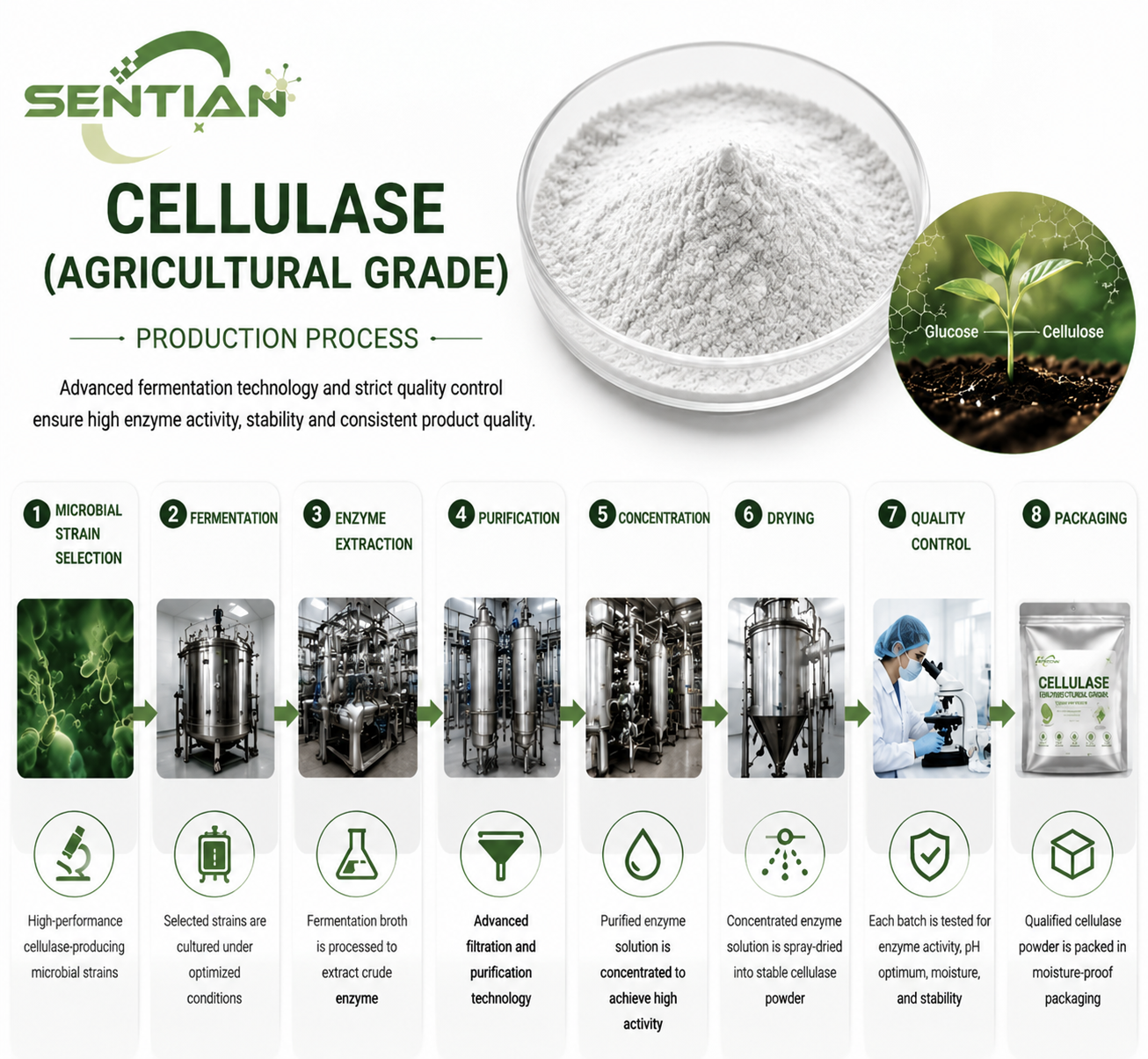
 ApplicationsCellulase is widely used in:1.Biofertilizer formulations2.Organic fertilizer production3.Straw decomposition products4.Compost fermentation additives5.Soil improvement products6.Agricultural enzyme solutionsCrop Cultivation
 Applications include:1.Field crop production2.Vegetable cultivation3.Fruit crop management4.Nursery substrate improvement5.Sustainable crop production programs
ApplicationsCellulase is applied in:1.Agricultural residue decomposition2.Organic matter transformation3.Soil fertility improvement4.Nutrient cycling management5.Soil health improvementSustainable Farming
Applications include:1.Organic agriculture systems2.Eco-friendly farming solutions3.Agricultural waste recycling4.Sustainable cultivation technologiesQuality ControlCellulase quality is evaluated through multiple testing methods.
Main quality tests include:1.DNS colorimetric method for cellulase activity determination2.Moisture content analysis3.Particle size testing3.Heavy metal detection4.Microbial contamination testingEach production batch can be tested according to quality requirements and provided with a COA quality report.
Why Choose Cellulase (Agricultural Grade)?
1.Suitable for agricultural enzyme applications 2.Produced through microbial fermentation technology 3.Stable enzyme activity and powder form 4.Supports cellulose degradation and organic matter conversion 5.Suitable for biofertilizer and organic fertilizer formulations 6.Compatible with agricultural waste treatment systems 7.Available in different enzyme activity specifications 8.Supports sustainable agricultural practices 9.Suitable for customized formulation development 10.Provides consistent product quality for agricultural applications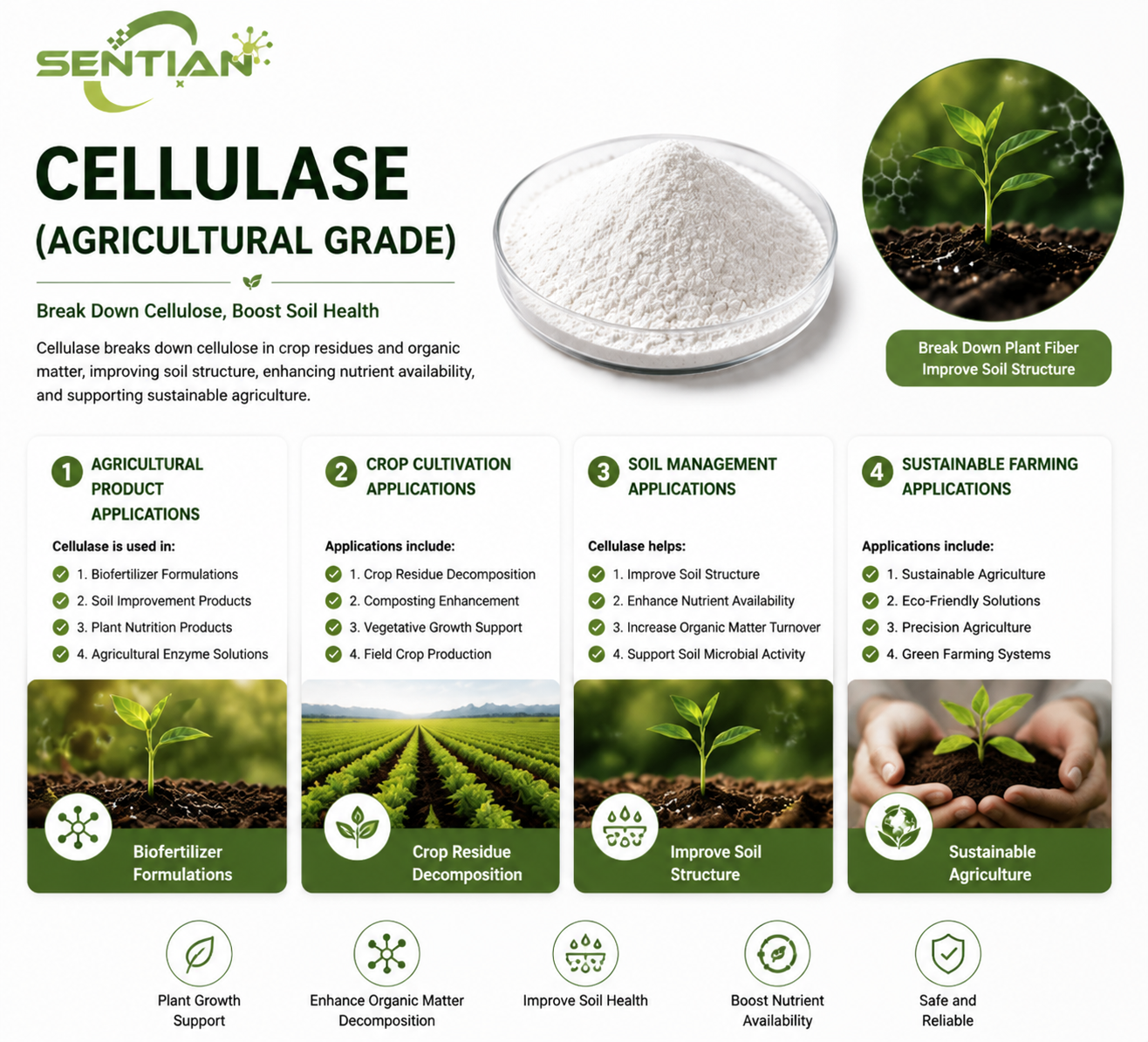
 The agricultural industry is increasingly adopting biological solutions to improve resource utilization, reduce agricultural waste, and support sustainable farming practices.Cellulase (Agricultural Grade) continues to attract attention due to its role in organic material decomposition, fertilizer production, and soil management applications.
 Key market trends include:1.Growing demand for biological fertilizer additives 2.Increasing utilization of agricultural waste resources 3.Rising interest in sustainable farming technologies 4.Expansion of organic fertilizer production 5.Greater focus on soil health management
 What is Cellulase (Agricultural Grade)?
 Cellulase (Agricultural Grade) is an agricultural enzyme preparation that breaks down cellulose in plant residues and organic materials, supporting decomposition and nutrient cycling.
What is the main function of Cellulase in agriculture?
The main function of Cellulase is cellulose degradation, helping accelerate straw decomposition, organic fertilizer fermentation, and agricultural waste utilization.
How does Cellulase improve organic fertilizer production?
Cellulase breaks down plant fiber structures, making organic materials easier for microorganisms to transform during fermentation.
Where is Agricultural Grade Cellulase used?
It is widely used in biofertilizers, organic fertilizers, straw decomposition products, soil improvement formulations, and agricultural enzyme solutions.
Can Cellulase be combined with microbial fertilizers?
Yes. Cellulase can be combined with beneficial microorganisms such as Bacillus species to support organic material decomposition and fermentation processes.
What are the storage requirements for Cellulase Powder?
Cellulase Powder should be stored in a cool, dry, sealed environment away from moisture, direct sunlight, high temperature, and strong acidic or alkaline substances. Cellulase (Agricultural Grade) is an efficient agricultural enzyme powder designed for cellulose degradation, organic fertilizer production, and soil improvement applications.Through microbial fermentation technology and controlled enzyme processing, Cellulase provides stable enzyme activity and flexible formulation compatibility.
 With increasing demand for sustainable agriculture, organic waste recycling, and biological fertilizer solutions, Agricultural Grade Cellulase continues to serve as an important enzyme ingredient for modern agricultural applications.


 Contact Now


 Key features include:1.Promotes cellulose degradation of agricultural residues2.Accelerates straw and organic material decomposition3.Supports organic fertilizer fermentation processes4.Improves utilization efficiency of plant waste resources5.Helps release nutrients from fiber-based organic materials6.Suitable for biofertilizer and soil improvement formulations

 Microbial Fermentation → Enzyme Extraction → Purification → Concentration → Drying → Quality Control → Packaging
 ApplicationsCellulase is widely used in:1.Biofertilizer formulations2.Organic fertilizer production3.Straw decomposition products4.Compost fermentation additives5.Soil improvement products6.Agricultural enzyme solutionsCrop Cultivation
 The agricultural industry is increasingly adopting biological solutions to improve resource utilization, reduce agricultural waste, and support sustainable farming practices.Cellulase (Agricultural Grade) continues to attract attention due to its role in organic material decomposition, fertilizer production, and soil management applications.
 What is Cellulase (Agricultural Grade)?
 Cellulase (Agricultural Grade) is an efficient agricultural enzyme powder designed for cellulose degradation, organic fertilizer production, and soil improvement applications.Through microbial fermentation technology and controlled enzyme processing, Cellulase provides stable enzyme activity and flexible formulation compatibility.


