


Send Message
Privacy statement: Your privacy is very important to Us. Our company promises not to disclose your personal information to any external company with out your explicit permission.
News
Home > Industry News > Vitamin E: Exploring Its Growing Applications in Dietary Supplements, Functional Foods and Cosmetics
2026-11-05
Vitamin E continues to play an important role in the global nutraceutical, food, and personal care industries. Recognized for its antioxidant properties, Vitamin E is widely used in dietary supplements, functional foods, fortified beverages, skincare formulations, and pharmaceutical preparations.
As consumers become increasingly interested in nutritional balance, antioxidant ingredients, and preventive wellness, manufacturers are exploring different Vitamin E formulations to meet diverse product development requirements.
For supplement brands and manufacturers, choosing the right Vitamin E raw material involves more than simply selecting a vitamin ingredient. Factors such as chemical form, source, concentration, stability, bioavailability, and formulation compatibility all deserve attention.
This makes Vitamin E a valuable ingredient for manufacturers developing multivitamin supplements, antioxidant formulas, softgel capsules, functional beverages, and skincare products.
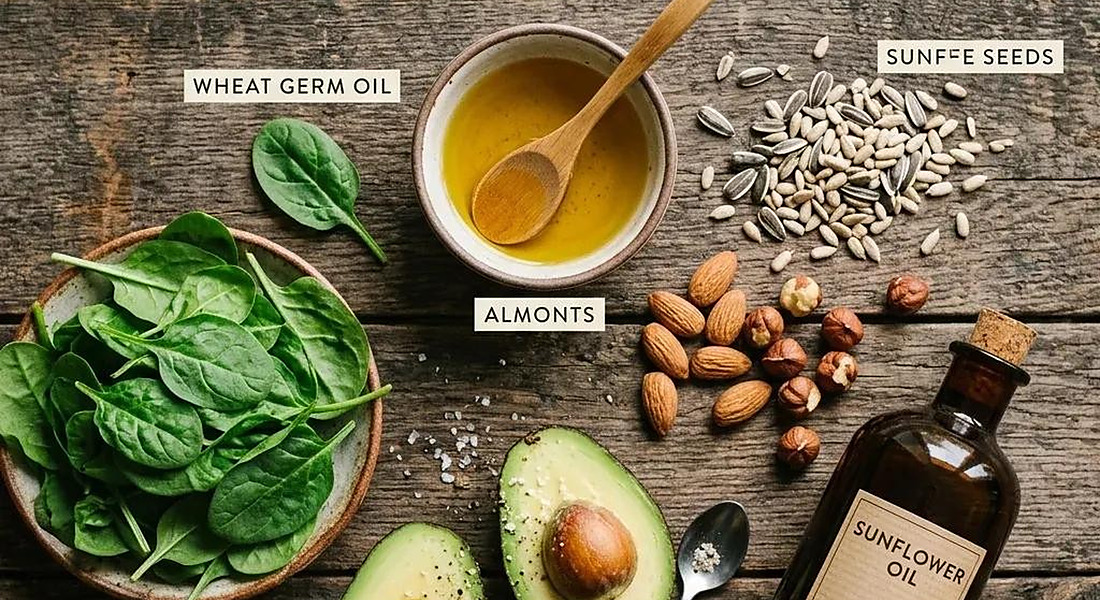
Vitamin E is a fat-soluble vitamin and a group of naturally occurring compounds with antioxidant activity.
It consists of eight related compounds:
Alpha-tocopherol
Beta-tocopherol
Gamma-tocopherol
Delta-tocopherol
Alpha-tocotrienol
Beta-tocotrienol
Gamma-tocotrienol
Delta-tocotrienol
These compounds are divided into two main categories: tocopherols and tocotrienols.
Among them, alpha-tocopherol is the form recognized as meeting human vitamin E requirements.
Vitamin E is naturally found in vegetable oils, nuts, seeds, and green leafy vegetables. Sunflower oil, wheat germ oil, almonds, and sunflower seeds are particularly well-known dietary sources.
For industrial applications, Vitamin E is available in different forms, including natural and synthetic alpha-tocopherol, alpha-tocopheryl acetate, mixed tocopherols, and tocotrienol-rich ingredients.
Understanding the differences between Vitamin E forms is essential for supplement manufacturers and ingredient buyers.
Natural Vitamin E is commonly identified as D-alpha-tocopherol or RRR-alpha-tocopherol.
It is generally obtained from natural vegetable oil sources and is widely used in premium dietary supplements and nutritional formulations.
Key characteristics:
Naturally sourced Vitamin E
High biological activity
Suitable for dietary supplement formulations
Commonly used in softgel capsules and liquid supplements
Synthetic Vitamin E is commonly known as DL-alpha-tocopherol or all-rac-alpha-tocopherol.
It is manufactured through chemical synthesis and is widely used in nutritional supplements and food fortification applications.
It offers manufacturers another option when considering formulation requirements, availability, and cost.
Vitamin E acetate is an esterified form of Vitamin E designed to offer improved stability compared with free alpha-tocopherol under certain storage and formulation conditions.
It is commonly used in:
Vitamin E softgel capsules
Multivitamin supplements
Nutritional oils
Fortified food products
Cosmetic and skincare formulations
Mixed tocopherols contain different forms of tocopherols, typically including alpha-, beta-, gamma-, and delta-tocopherols.
They are widely valued for their antioxidant properties and can be used in nutritional products and as antioxidants in certain food and oil applications, subject to applicable regulations.
Tocotrienols are another group of Vitamin E compounds with a chemical structure different from tocopherols.
They are attracting interest in specialized nutraceutical research and product development, particularly in premium antioxidant and wellness formulations.

Dietary supplements remain one of the major application areas for Vitamin E ingredients.
Vitamin E is commonly incorporated into:
Vitamin E capsules
Vitamin E softgels
Multivitamin and mineral supplements
Antioxidant supplement formulas
Omega-3 and fish oil combination products
Vitamin A, D, E and K formulations
Beauty and skin health supplement products
Manufacturers can select natural Vitamin E, synthetic Vitamin E, or Vitamin E acetate depending on their product positioning and formulation requirements.
Vitamin E is also used in food fortification and functional food development.
Potential applications include:
Fortified nutritional drinks
Functional beverages
Nutritional powders
Meal replacement products
Dairy and plant-based nutritional products
Fortified cereals and food products
Edible oils and fat-based food systems
Because Vitamin E is fat-soluble, its dispersion, compatibility with the product's oil phase, and processing conditions should be evaluated during formulation development.
Vitamin E is widely used in cosmetic formulations because of its antioxidant and skin-conditioning properties.
Common applications include:
Facial serums
Moisturizing creams
Anti-aging skincare formulations
Body lotions
Hair care products
Skin oils
Lip care products
Tocopherol and tocopheryl acetate are among the Vitamin E ingredients used in personal care formulations.
Certain tocopherols are also used as antioxidants in food and edible oil applications.
They can help protect susceptible fats and oils against oxidation, supporting product quality and oxidative stability.
This is particularly relevant for products containing vegetable oils, essential fatty acids, and other oxidation-sensitive lipid ingredients.
The appropriate tocopherol type and dosage depend on the food matrix, processing conditions, and local food additive regulations.
For B2B buyers, selecting a reliable Vitamin E supplier is an important part of product development and quality management.
Here are several factors worth evaluating:
1. Ingredient Form
Confirm whether the required material is D-alpha-tocopherol, DL-alpha-tocopherol, Vitamin E acetate, mixed tocopherols, or tocotrienols.
2. Assay and Purity
Check the ingredient's assay, active content, and relevant analytical methods against the product specification.
3. Natural or Synthetic Source
Determine whether the final product requires natural-source Vitamin E or whether synthetic Vitamin E is suitable.
4. Physical Form
Depending on the application, Vitamin E may be supplied in oil, liquid concentrate, powder, or other formulation-specific forms.
5. Stability and Storage
Vitamin E is sensitive to oxidation under certain conditions. Packaging, temperature, light exposure, and storage conditions should be considered to maintain ingredient quality.
6. Quality Documentation
Professional ingredient buyers should request relevant technical and quality documents, including:
Certificate of Analysis (COA)
Product Specification
Safety Data Sheet (SDS)
Allergen Statement, where applicable
GMO Statement, where applicable
Origin and traceability information
Relevant certifications and regulatory documentation
7. Regulatory and Market Requirements
Manufacturers targeting the EU, USA, and other international markets should verify the permitted ingredient form, applicable food or supplement regulations, labeling requirements, and intended use before product commercialization.
The development of premium nutritional supplements is creating opportunities for a wider range of Vitamin E ingredients.
Rather than relying exclusively on conventional single-vitamin products, supplement manufacturers are exploring combination formulas that bring together different nutritional ingredients.
Examples include:
Vitamin E + Vitamin C antioxidant formulas
Vitamin E + Selenium nutritional supplements
Vitamin E + Omega-3 softgel formulations
Vitamin E + Coenzyme Q10 combinations
Vitamin E + Vitamin A and D multivitamins
Tocotrienol-based specialty supplement formulations
These combinations provide opportunities for product differentiation, although formulation compatibility, ingredient stability, appropriate dosage, and substantiation of product claims remain essential.
For OEM and private label manufacturers, selecting suitable raw materials and optimizing the formulation are important steps in developing competitive finished products.
Choosing the right raw material supplier is just as important as choosing the right ingredient.
At Xi'an Sentian Biotechnology Co., Ltd., we focus on providing nutritional ingredients and OEM manufacturing solutions for global supplement brands and manufacturers, particularly in the EU and USA markets.
Our ingredient sourcing and supply capabilities support customers developing a variety of nutritional products, including capsules, softgels, tablets, powders, and functional formulations.
When sourcing Vitamin E or other nutritional ingredients, customers can discuss their requirements with our team, including:
Required Vitamin E form and specification
Target assay and concentration
Natural or synthetic source preference
Intended application and dosage form
Required documentation and quality standards
Order quantity and packaging requirements
We aim to support customers throughout the ingredient sourcing and product development process, from raw material selection to finished product manufacturing.
Looking for a reliable Vitamin E raw material supplier?
Contact Sentian Bio to discuss your Vitamin E sourcing requirements and explore ingredient solutions for your next nutritional supplement or functional food project.
Q1: What is the difference between natural and synthetic Vitamin E?
Natural Vitamin E is generally identified as D-alpha-tocopherol (RRR-alpha-tocopherol), while synthetic Vitamin E is commonly identified as DL-alpha-tocopherol (all-rac-alpha-tocopherol). They differ in stereochemical composition and biological activity. On an equal-weight basis, natural alpha-tocopherol has approximately twice the vitamin E activity of synthetic alpha-tocopherol.
Q2: What is the difference between Vitamin E and Vitamin E acetate?
Vitamin E generally refers to tocopherol compounds, while Vitamin E acetate is an esterified form of alpha-tocopherol. The acetate form is often selected for its improved stability in certain formulations.
Q3: Is Vitamin E suitable for softgel manufacturing?
Yes. Vitamin E and Vitamin E acetate are commonly used in softgel formulations. The specific ingredient form and formulation should be selected according to the desired active content, compatibility, and manufacturing process.
Q4: Can Vitamin E be used in cosmetics?
Yes. Tocopherol and tocopheryl acetate are commonly used in cosmetic and personal care products, including facial serums, moisturizers, creams, and skin oils.
Q5: What documents should I request when purchasing Vitamin E powder or oil?
Buyers should request a Certificate of Analysis (COA), product specification, Safety Data Sheet (SDS), and other relevant quality, origin, allergen, and regulatory documents according to their application and market requirements.
Conclusion
Vitamin E remains a versatile ingredient across the nutraceutical, functional food, food processing, and cosmetic industries. With several available forms and a wide range of applications, it offers manufacturers flexibility in developing nutritional and personal care products.
Understanding the differences between tocopherols, tocotrienols, natural Vitamin E, synthetic Vitamin E, and Vitamin E acetate can help buyers make more informed sourcing and formulation decisions.
Share to:


Send Inquiry

Ms. Linda
Tel:
Fax:
Mobile Phone:+86 18602905487
Email:sales3@sentianbio.com
Address:Room 2002, Building B, Economic Development Building, Weiyang District, Xian, Shaanxi
Related Products List
Mobile Site

Privacy statement: Your privacy is very important to Us. Our company promises not to disclose your personal information to any external company with out your explicit permission.
Fill in more information so that we can get in touch with you faster
Privacy statement: Your privacy is very important to Us. Our company promises not to disclose your personal information to any external company with out your explicit permission.